


Energy Eats Intelligence:
Geothermal
How geothermal makes power, what it sells for, and what it might take to build a well at 450°C that produces seven times the power.
Prime Movers Lab and Roger Carter
October 2026
In brief
Since 2022, buyers including Google, Meta and Southern California Edison have contracted nearly 1.2 gigawatts of geothermal power from plants not yet built. The published prices, $105 to $107 a megawatt-hour, are about what new conventional geothermal and solar with storage cost.
This paper explains how heat is taken out of rock, and what the industry has shown so far. It follows the work from finding hot rock to turning its heat into electricity, and at each step reports what is proven on the public record and what is not.
So far: Fervo’s Cape Station ran a 30-day test at 8 to 10 megawatts and put its first 33-megawatt unit into commercial operation on September 30, 2026. Its Nevada wells have produced for two years at a third of Cape’s design flow with little cooling. Fervo’s drilling time fell from 71 to 21 days over nine wells. Financing is the hard part: of the geothermal capacity proposed to federal statisticians between 2010 and 2020, only 16 to 38% got built, depending on how you count.
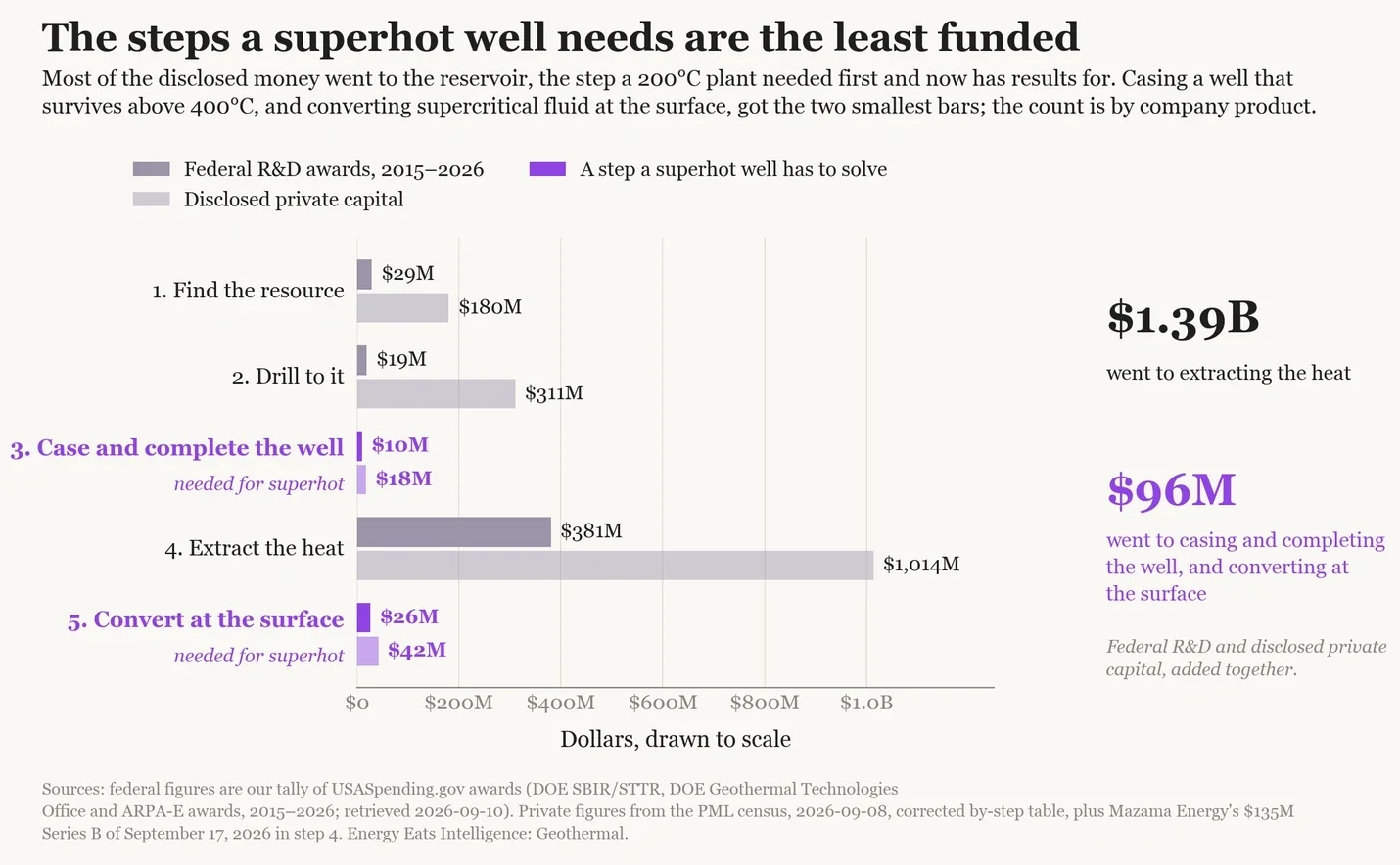
The prize is temperature. Fluid at 450°C carries four times the heat of today’s 200°C brine and yields 7 to 12 times the electricity per well. Such a well needs casing that survives, tools that work there, and a plant that can use supercritical fluid. Those three have had less than $100 million of research and private capital since 2015, against $1.39 billion for the reservoir (our tally, in Part 4).
Two conclusions follow: keep building the plants that now sell at $105 to $107 a megawatt-hour, and keep finding natural reservoirs, which exploration companies such as Zanskar are still discovering. And fund the three steps that would let a well go hotter.
The buyers signed because they need firm, carbon-free power badly and because the engineering to supply it has changed. Google’s contracts, Amazon’s, Meta’s, Southern California Edison’s and those of a dozen California community power agencies are mostly in force; the rest are signed and awaiting a regulator’s approval. The most recent, Google’s third with the same developer, Fervo Energy, is for 396 megawatts from Cape Station in Utah, whose first unit reached commercial operation on September 30, 2026, a day ahead of its contract date.
Why now
Our Power Generation paper argued that the binding constraint on the artificial-intelligence build-out is electricity, and firm electricity in particular. Microsoft is paying to restart a closed nuclear plant and waiting four years for the first electron; Meta put out a request for gigawatts of reactors that hadn’t been built. Geothermal is the other firm, carbon-free source, and the heat is already there under most of the continent. The problem is reaching it and bringing it up at a price the market will pay.
Prime Movers Lab has followed this sector since a November 2021 webinar (recording) with the founders of Fervo and Quaise, and published a primer on superhot rock and a survey of the field in 2024. This paper works in more detail from the public record that now exists: the contracts, the well permits, the state production data and the cost studies.
Part 1. The basics
Geothermal power needs three things: rock hot enough to boil water, a way to collect heat from a large volume of that rock and bring it to the surface, and a machine that turns heat into electricity. The rock is the easy part. A few kilometers down it is hot enough to boil water under most of the continents, and the deeper you go, the hotter it gets. Collecting the heat is the hard part, for two reasons. Rock holds heat well and gives it up slowly, so a fluid has to move through it or past it to pick the heat up and carry it to the surface. And rock holds little energy for its volume, compared with a fuel. A cubic meter of granite cooled by 100°C gives up about 225 megajoules, and the US Geological Survey reckons that only a tenth to a quarter of a reservoir’s heat can actually be produced, so perhaps 20 to 55 megajoules from that cubic meter. A cubic meter of oil-bearing rock yields roughly 800 megajoules of recoverable energy, and a cubic meter of gas-bearing rock 450 to 500 (our arithmetic, at ordinary porosities and recovery factors). A geothermal well has to sweep a great deal of rock to gather what an oil well finds in the pore space. Turning heat into electricity is ordinary engineering: a turbine and a generator. The hotter the fluid arrives, the more electricity each kilogram of it yields.
The heat does not have to become electricity at all. Hot water piped straight into buildings has warmed Boise, Idaho since 1892 and supplies about 90% of the energy Iceland uses to heat its homes. Counted in installed capacity, geothermal heat used directly (most of it through heat pumps) is about six times larger worldwide than geothermal electricity: 108 gigawatts of heat at the end of 2019 against 17 gigawatts of power at the end of 2025. This paper is about electricity, but the same wells and the same heat serve both.
For electricity, nature has to supply the hot rock, a fluid, and enough permeability for the fluid to move through the rock fast enough to matter, all in one place. It rarely does where anyone has looked. Sixty years of effort produced about 4 gigawatts of geothermal power in the United States, most of it where hot water was already leaking to the surface. That conventional fleet, run by Ormat, Calpine and a handful of others, has delivered firm power for decades. Heat comes out of rock in one of three ways, described next. How hot the rock should be is a separate question, and it applies to all three approaches.
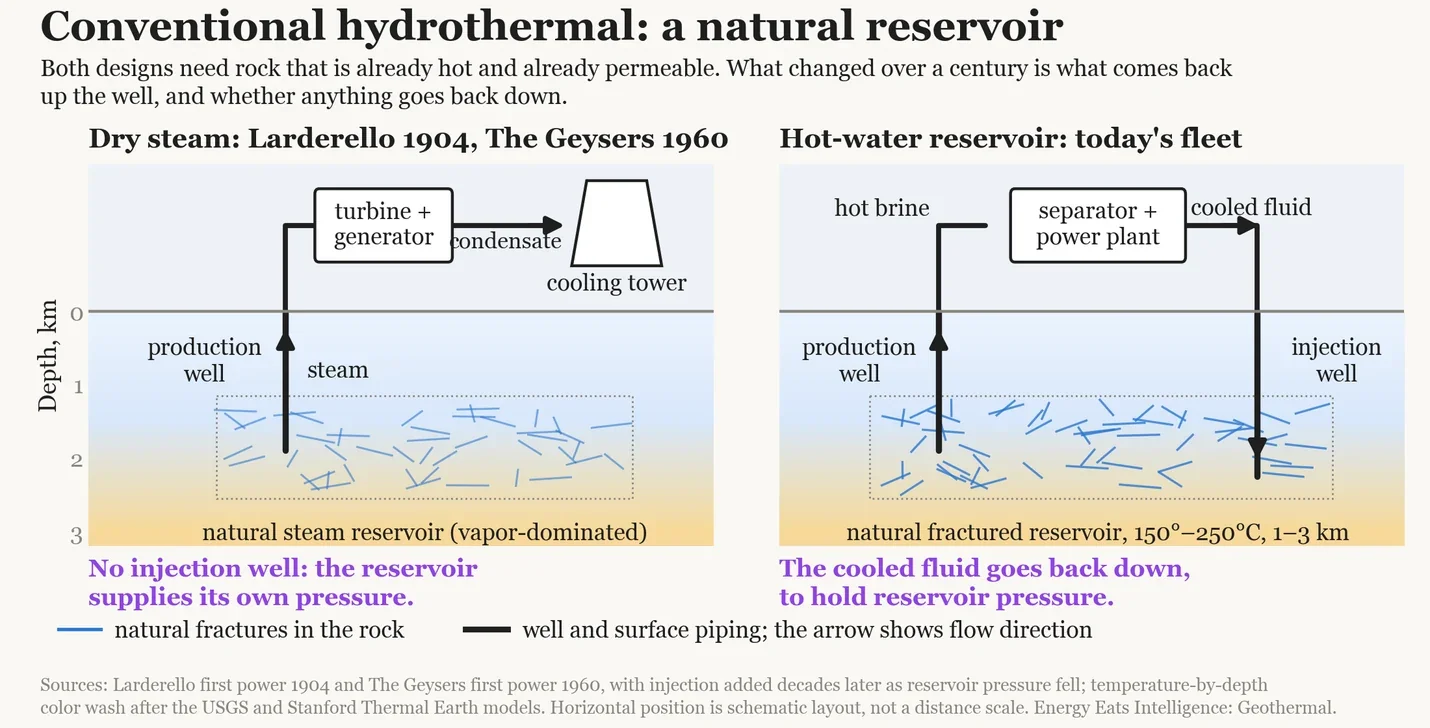
Find a natural reservoir and drill into it. The earliest plants, at Larderello in Italy from 1913 and at The Geysers in California from 1960, ran on steam that was already there, in rock permeable enough for water to circulate and heat up on its own. Nothing was injected. Operators began returning the condensed steam after the turbine in 1969, mostly to be rid of it. After the field peaked at 2,043 megawatts in 1987, the reservoir was giving up more water than nature replaced and pressure fell, so they began adding water from outside; today The Geysers injects treated wastewater piped in from Lake County and Santa Rosa to hold the pressure up. Most of today’s fleet produces hot water rather than steam: a production well brings it up, a plant takes the heat, and an injection well returns the cooled fluid to the reservoir so the pressure holds and the brine stays underground.
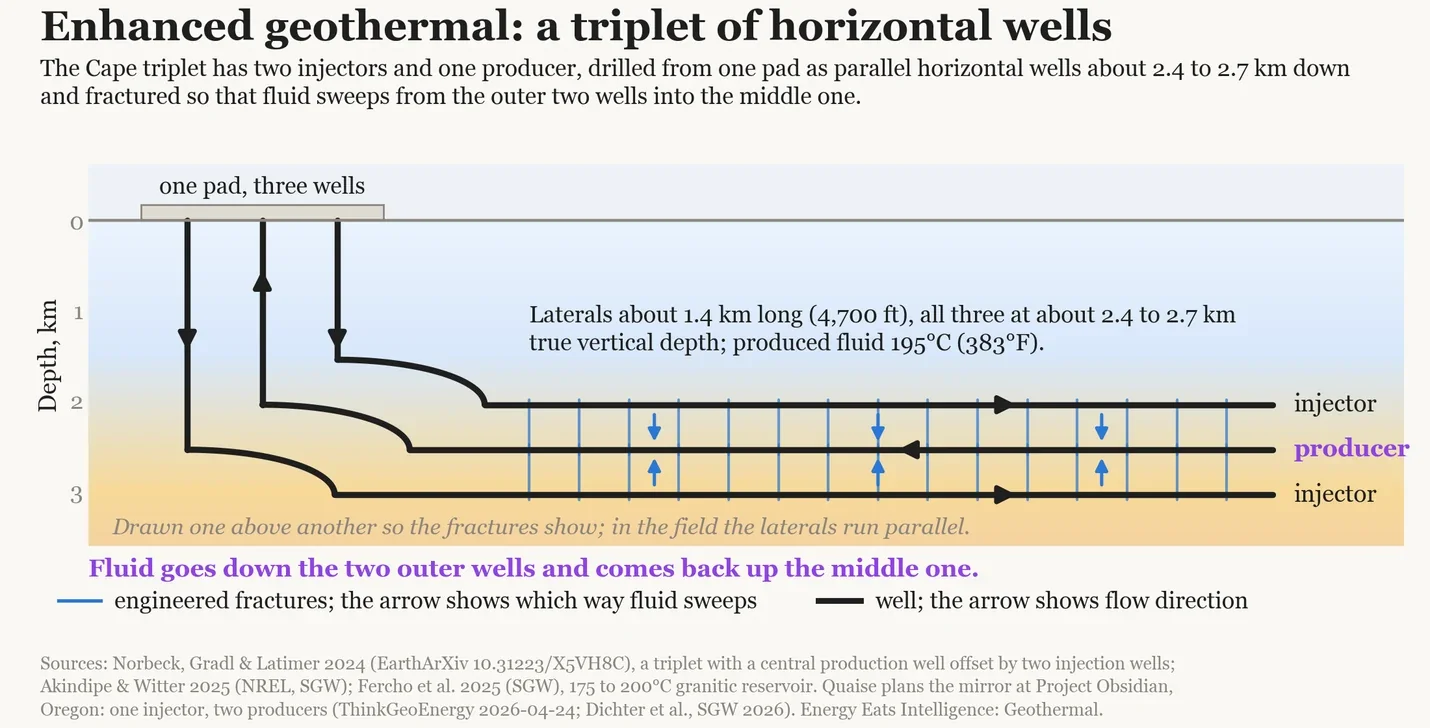
Make the permeability yourself. Drill horizontal wells into hot rock that has too little natural permeability to produce, fracture the rock between them, and pump a fluid from one well to the other through the fractures. The fluid picks up heat from every fracture surface it touches on the way. This is enhanced geothermal, and most of the new contracts buy it. Fervo drills its Cape Station wells as triplets, one producer between two injectors.
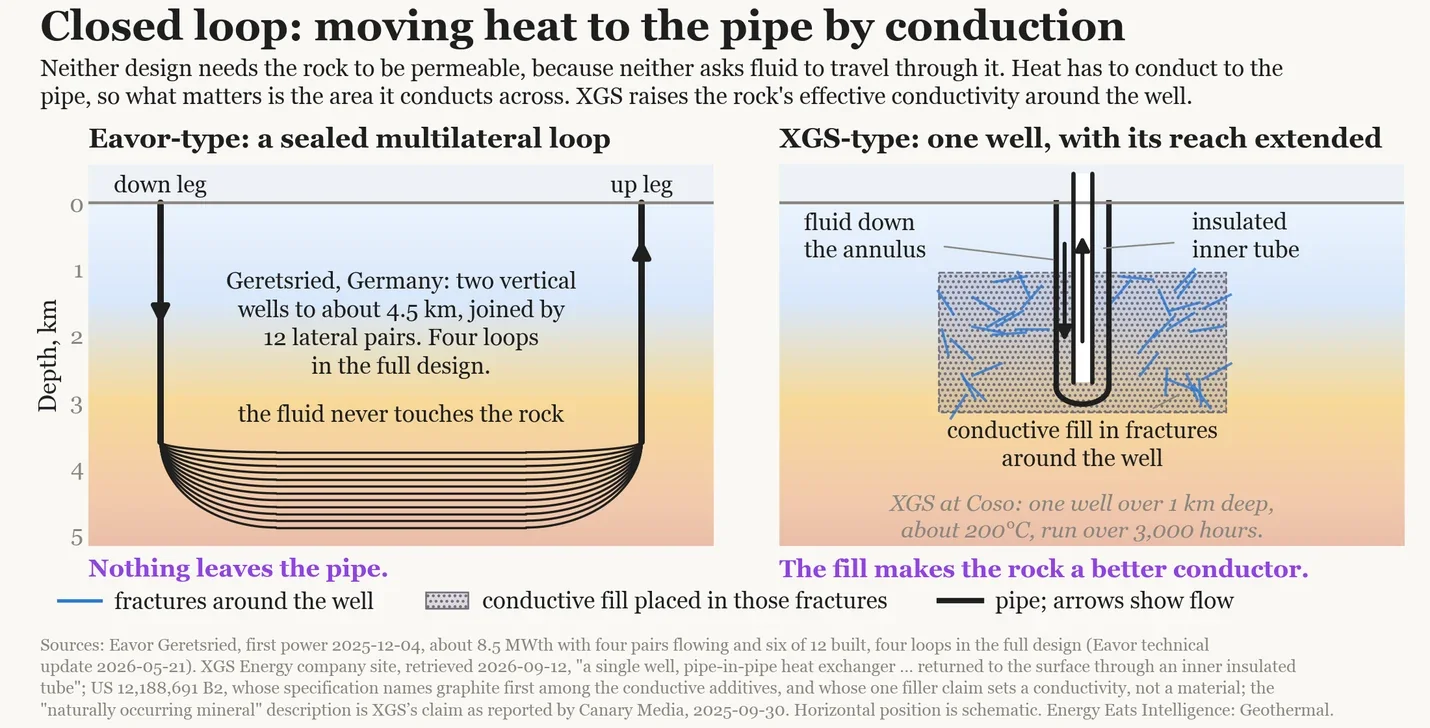
Skip permeability with a sealed loop. The fluid never leaves the pipe; heat conducts into it through the pipe wall. Eavor does this with pairs of long horizontal laterals joined at depth; its German loop produces at about 160°C. XGS Energy does it with a single well. It fractures the rock around the well, fills the fractures with a thermally conductive material, so the nearby rock carries heat to the pipe faster, and circulates the fluid down the outside of the well and up an insulated inner tube. Neither design has yet shown how it behaves in the hot crystalline rock the superhot programs are drilling toward.
Then, how hot
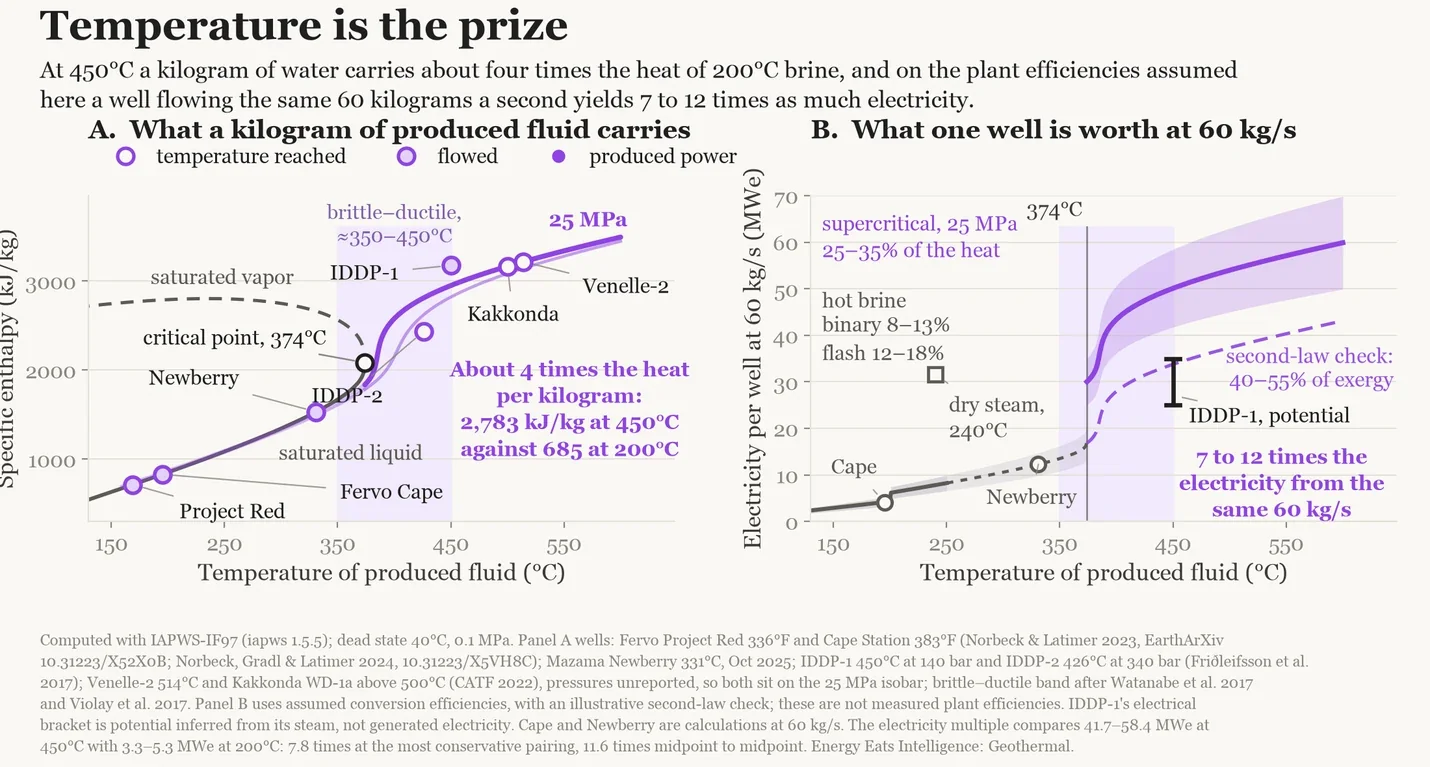
Above 374°C, water under enough pressure (221 bar) stops being either liquid or steam and becomes a supercritical fluid that carries several times the energy per kilogram of the brine today’s plants produce. This paper calls rock above that temperature superhot, following the critical point; some in the industry draw the line at 400, and the engineering bars in this paper are set at 400 because the programs now drilling are aiming there. Wells in the lower 48 have reached 400°C, logged at 11,000 feet at The Geysers, but in a low-pressure steam system, and no well in the United States has yet produced supercritical fluid.
Going hotter raises the output of any of the three methods, and a developer still has to choose one. Quaise plans its first Obsidian reservoirs, at 315 and 365°C, as fractured triplets of one injector and two producers, the mirror of Fervo’s; at those temperatures they are enhanced geothermal below the superhot line. Mazama is enhanced geothermal at 331°C and above. Iceland’s deep wells go after natural permeability in volcanic fields, the conventional method taken deeper, though IDDP-2 was stimulated with cold water when its deepest zones took little fluid.
Several programs are drilling toward it now. Mazama Energy was drilling a well at Newberry in Oregon in September 2026 toward a planned 15,500 feet and temperatures above 750°F, about 400°C, with a $20 million Department of Energy award and, since September 17, $135 million of new private capital behind it. Quaise Energy’s Project Obsidian next door states a 400°C target for its drilling system. Iceland’s IDDP-3 at Nesjavellir is aiming past 400°C, and New Zealand has funded a supercritical well at Rotokawa. Japan has budgeted about $690 million for next-generation geothermal from 2026 to 2030, supercritical work included, and has chosen Yuzawa as the first site of a separate deep-exploration program.
The energy per kilogram that hot fluid carries rises steeply with temperature and jumps above the critical point. From the international steam tables, a kilogram of 450°C supercritical fluid carries about four times the heat of 200°C brine and, through a power plant, 7 to 12 times the electricity per well at the same flow, depending on the plant and the reference temperature assumed. The chart below works it through at 60 kilograms per second. Fewer wells per megawatt is most of the cost case for superhot rock, and Part 3 follows it through to the price of electricity. Temperature is one of three levers, alongside how fast a well can flow and how slowly its produced temperature declines, and the next section takes up the other two.
A word on safety. A geothermal plant has no fuel inventory, no chain reaction and no decay heat, so its risks differ from those of other sources such as nuclear fission. The hazards it does have are well documented. In 2009 Iceland’s IDDP-1 well drilled into molten rock at 2,104 meters; the magma flowed into the bottom of the hole, quenched to glass, and stopped, with no release at the surface. The well was completed above it and flowed 452°C steam at 140 bar for two years before failed surface valves ended it. Hawaii’s KS-13 well did the same at 2,488 meters in 2005 and was finished as an injection well. Magma rising out of a well is not a documented risk. However, the industry does take two hazards seriously. Hydrogen sulfide in the produced fluid killed five people at an Indonesian plant in 2021, and operating plants meet it with gas monitoring and abatement. The second is induced seismicity. Hydraulic stimulation near Pohang, South Korea, triggered a magnitude 5.4 to 5.5 earthquake in 2017 that injured 135 people, and enhanced-geothermal projects now run under traffic-light protocols that slow or stop injection when measured shaking passes set thresholds. Operators publish their monitoring records under such protocols; Cape Station’s is public.
How fast a well cools. Rock stores a great deal of heat but conducts it slowly. A working fluid picks heat up from the rock surfaces it touches, and those surfaces cool first; how fast depends on how much surface the fluid reaches and how hard you pump. Pump gently and a well runs at a nearly constant temperature for decades. Pump hard and the same rock cools within years, unless the design reaches enough rock that what is drawn out is small against what is stored.
How much rock a megawatt needs. A quick calculation of our own. In the case of a closed system, take a pipe 20 centimeters across in rock 100°C hotter than the fluid inside it. Use the textbook formula for heat flowing out of rock into a long pipe, with rock of ordinary properties (it conducts 3 watts per meter per degree, and heat spreads through it at one millionth of a square meter per second). After 10 years the pipe draws about 340 watts per meter of its length, and the figure keeps falling, toward 300 by year 30. A million watts divided by 340 is about 3 kilometers, so a megawatt of heat needs roughly 3 kilometers of pipe in contact with hot rock, and a megawatt of electricity, at the 4 to 10% a low-temperature plant converts, needs 30 to 75 kilometers. Eavor’s design for Geretsried, 48 lateral pairs of about 6 kilometers each, roughly 288 kilometers of lateral for 8.2 megawatts of electricity (our multiplication of the company’s figures), sits on that line. It also shows what the idealized number leaves out. At its five-year design point that design draws about 220 watts from each meter of pipe rather than 340: the fluid warms as it travels, so the temperature difference driving the heat is smaller, and neighboring laterals cool the same rock. A real loop needs more pipe than a single pipe in undisturbed ground would suggest. So a closed loop is drilled as tens of kilometers of lateral, and enhanced geothermal fractures the rock instead of piping through it. Fervo assumes a single Cape production well touches about 2.8 million square meters of fracture surface, where 60 kilometers of 20-centimeter pipe has a surface of about 38,000; the fractures touch roughly 70 times more rock (our arithmetic).
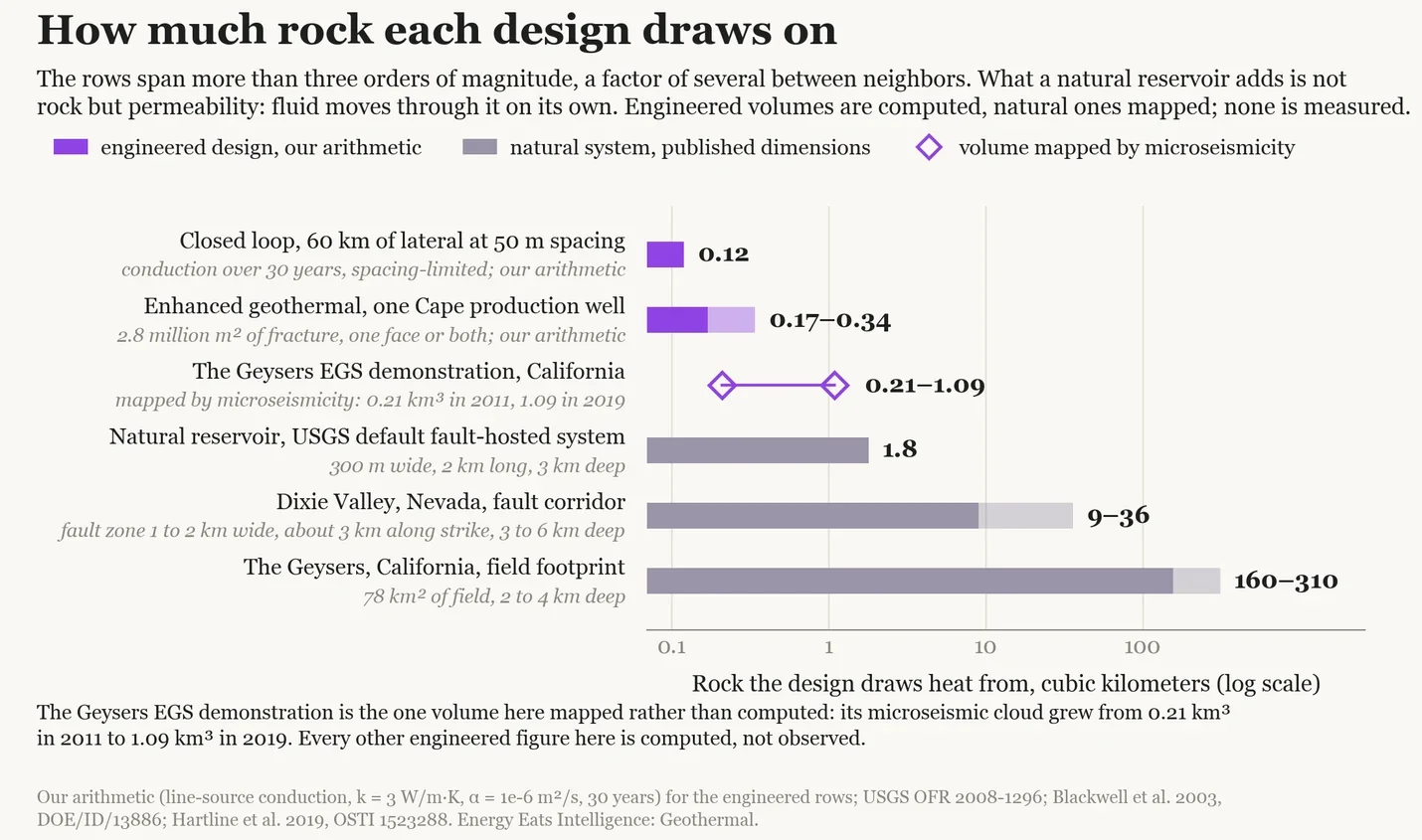
Surface area is not the whole of it, because heat has to travel through rock to reach that surface. Over 30 years heat moves about 60 meters through granite, so a fracture face or a pipe wall draws heat from a slab of rock some 60 meters thick on either side of it, not only from the rock it touches, and the size of that slab sets how much heat there is to take. On our arithmetic, Fervo’s fracture network draws on 0.2 to 0.35 cubic kilometers over 30 years, and a 60-kilometer closed loop with laterals 50 meters apart in the same area draws on about 0.1. A natural reservoir draws on far more; the Geological Survey’s default dimensions for a fault-hosted system, a few hundred meters wide, two kilometers along the fault and three deep, enclose about 1.8 cubic kilometers, and the largest, Dixie Valley, 10 or more on its mapped fault zone (our arithmetic in both cases). Each design sits a factor of several from the next, and the four together span two orders of magnitude. One stimulated volume mapped by its small earthquakes, at an enhanced-geothermal demonstration inside The Geysers, grew from 0.2 cubic kilometers to 1.1 over eight years of injection, of the same order as the engineered figures above. In a natural reservoir the fluid moves through that rock on permeability that is already there. The engineered designs have to make that permeability, and the fluid moves along a path someone built.
Part 2. Five steps
One way to think about the technical systems required for geothermal energy is as five steps: find the resource, drill to it, case the well so it survives, extract the heat, and convert it at the surface.
Find the resource
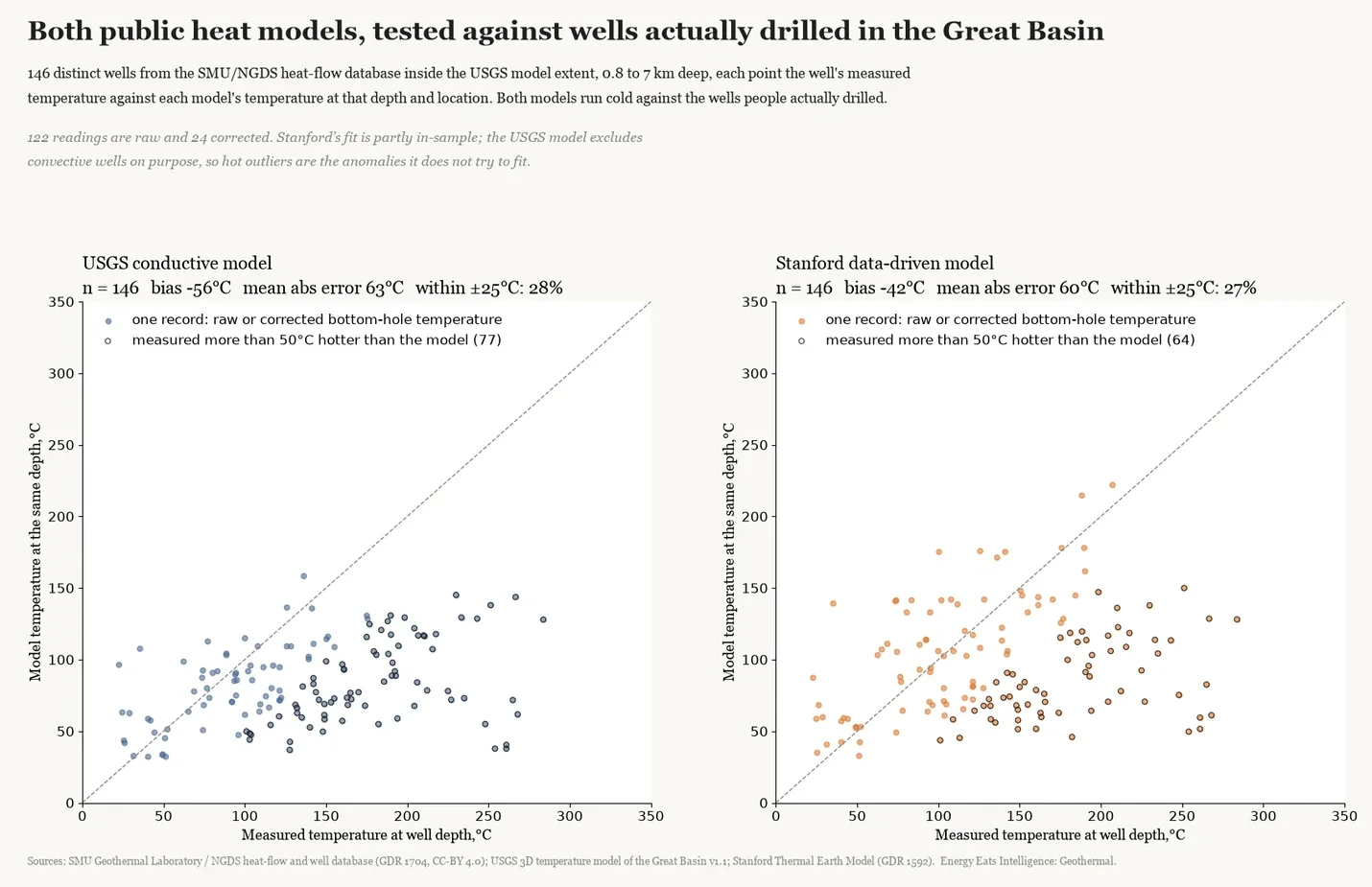
Underground temperature can be measured only where someone has drilled, so everywhere else it is modeled: from surface heat flow, rock type and the assumption that heat rises through the crust by conduction. The two public models of the American West, the US Geological Survey’s and Stanford’s, were tested against 146 wells actually drilled in the Great Basin. Both underpredict, by 56 and 42°C on average, and 61 of the wells are more than 50°C hotter than both models say. Most of those readings are uncorrected bottom-hole temperatures, and the database does not record what kind of well they came from. On the 24 corrected readings, half of them logged as oil and gas wells, the gap is 18°C for one model and reversed for the other. Those 24 are a different set of wells as well as a corrected one (our arithmetic on the same file). Correcting the readings removes most of the average error but much less of the spread. Across all 146 wells, either model misses a drilled well by a standard deviation of about 60°C; on the corrected 24 the spread is 31 to 36°C, and even there, half the wells are missed by more than 25°C. A miss of 25°C at 200°C is a 27 to 31% error in the electricity a kilogram of fluid can make. A conductive model describes the background. Geothermal fields sit where faults let hot fluid rise, outside what such a model describes accurately.
Zanskar trains machine-learning models on legacy geological and geophysical data to site wells where there is no hot spring at the surface to point the way. In December 2025, it announced what it described as the first blind commercial geothermal discovery in the United States in more than 30 years, a hidden hydrothermal system at 121°C and 2,700 feet in western Nevada. It has raised about $190 million of equity, according to PitchBook, and in May 2026 it signed a 20-year, 100-megawatt contract with NV Energy, sleeved to Amazon. The next result from Zanskar is a production well at a site chosen from data alone. The company’s chief executive said in September 2026 that a good natural resource will beat any engineered one, “definitely true today, and we think probably indefinitely into the future”, because the permeability people can make is “an order of magnitude, and sometimes multiple orders of magnitude less than the type of natural permeability that we find in the Earth”. It reports its newest Lightning Dock production well flowing three to five times more, and about 50 times more easily, than the best enhanced-geothermal wells, from less than half their measured depth. Zanskar’s drilling will show whether the hidden conventional resource is large enough to matter; it is a different bet from the one the enhanced-geothermal developers have made. Fervo, in its April 2026 post on two years of production data, calls enhanced geothermal “proven at scale”. Zanskar describes next-generation drilling and stimulation as the expensive route it is trying to avoid, since matching a natural system’s temperature and permeability from the regional background would take wells near 10,000 feet and stimulation on top. It does borrow the oil industry’s bits and directional tools, and drilled its deepest Lightning Dock well about a third faster than any earlier well on the site.
Drill to it
Drilling is the job of removing rock from the bottom of a hole that typically starts about two feet across at the surface, narrows to 8 or 10 inches at the bottom, and runs several kilometers down, and of carrying the pieces to the surface. The hole gets hotter as it goes, and the fluid pressure inside it climbs with depth. Two properties of rock decide how it can be done. Rock is strong in compression and weak in tension, so it is cheaper to pull apart than to crush. And rock conducts heat badly, so heat put on its surface stays in a thin skin instead of spreading. Every drilling method does one of three things to the rock face: it touches the rock and breaks it, it heats the rock until it flakes, melts or boils away, or it shocks the rock from a distance. Whatever breaks the rock, the pieces then have to leave the hole.
A rotary rig does that with drilling fluid pumped down the pipe and back up the outside of it. The fluid lifts the cuttings out, cools the bit, and its weight holds back the pressure of whatever the rock contains, so it is the well’s first safety barrier as well as its conveyor. So drilling needs water, and a site’s water supply matters along with its rock: thousands of barrels to drill a deep well, 118,000 barrels of non-potable water to fracture Utah FORGE’s two wells in 2024, and a top-up for what a circulating reservoir keeps. Fervo reports that about 70% of what it injects at Project Red comes back at the production well under steady conditions, against 80 to 90% during the first 37-day test, the rest soaking into fractures and pore space around the loop. The company argues that fluid is not consumed, since it stays in the same formation, and expects later well designs to return nearly all of it. Cape Station holds a Utah water right for 9,490 acre-feet a year, granted in March 2026 over five protests including PacifiCorp’s.
A well’s cost is mostly rig time, and rig time depends on how fast the bit advances and on how often the whole string has to be pulled out of the hole to change a worn bit, which at depth takes half a day or more.
Contact drilling made every well in this paper. A roller-cone bit crushes rock under rolling teeth. A polycrystalline-diamond bit, a PDC, shears it with fixed diamond cutters and removes rock for less energy; it now drills more than 90% of the world’s footage. A hammer bit strikes the rock thousands of times a minute so that it fails in tension, the cheapest way to break it, and is the fastest of the three in granite near the surface. In hot crystalline rock, bit life slows all three. Once the wear surface of a diamond cutter passes about 350°C, the cutter wears 10 to 100 times faster. The bits on Utah FORGE’s second deep deviated well lasted 6.5 hours on average, and sixteen were used on that one well. Each change is a round trip. A hammer has a different limit: the air has to beat the pressure of the fluid column, and its seals fail between 100 and 300°C. A 300°C hammer built by Sandia and Atlas Copco has drilled more than 200 feet of granite at up to 300°C in tests, at over 100 feet an hour, but has not gone down a well. Even so, Sandia’s independent analysis of FORGE rig data found PDC bits sustaining more than 100 feet an hour over several hundred feet of granite, and Fervo’s eighth horizontal well averaged 70 feet an hour while drilling. Bit life and the associated replacement trips are what’s most costly.
The hottest wells were drilled with ordinary rigs. Every well that has reached superhot rock was made by contact drilling, and the trick was cooling. At Kakkonda in Japan, well WD-1a reached 3,729 meters and more than 500°C in 1995 by rotary drilling: a system chilled the returning mud, a top drive let the crew cool the bottom-hole assembly as each stand of pipe went in, and a steerable motor with measurement-while-drilling tools still worked at 2,600 meters in rock above 350°C. The 500°C were measured 159 hours after the pumps stopped. Iceland’s IDDP-1 was drilled the same way at Krafla in 2009 until the bit ran into molten rock at 2,104 meters. IDDP-2 deepened an existing Reykjanes well in 2016 and 2017 with a 350-ton rig and standard 12¼- and 8½-inch bits to 4,659 meters; it lost all circulation below 2.5 kilometers, so the last two kilometers were drilled with cold water pumped down and nothing coming back, and the casing never warmed past 100°C while the pumps ran. Six days after they stopped, the bottom of the hole read 426. Venelle-2 in Italy was deepened to 2.9 kilometers and 514°C in 2017 with a conventional rig as well. The circulating fluid is what makes this possible: pumped down the string and back up, it holds the bit and the hole far below the temperature of the rock around them. The heat arrives when the pumps stop. What ended these wells was not the drilling but what came after, valves, casing, cement and tools, the subject of the next step.
Rig rates are public: Nabors’ land rigs in the Lower 48 earned $33,555 a day in the second quarter of 2026, and Helmerich & Payne’s, which drill for Fervo at Cape, about $38,700 a day before pass-through costs in the company’s 2025 fiscal year. At Helmerich & Payne’s rate a 71-day well carries about $2.7 million of rig hire and a 21-day well about $0.8 million, our arithmetic. The rig is the smaller part of a bill of $5 to $10 million a well. Fervo’s engineers report that drilling time accounts for over 75% of a well’s cost once the services, tools and crews that bill by the day are counted; Sandia’s cost model for a vertical well puts that share far lower, at 22 to 37%. El-Sadi’s share is of total well cost; Sandia’s model is of a different, vertical well with its own cost categories, and the public record does not reconcile the two.
Thermal drilling breaks rock with heat rather than with a bit. A flame, a beam or a hot penetrator heats only the surface, and what happens next depends on how hard the surface is heated. Heated gently, the skin expands against the cold rock behind it and flakes off, which drillers call spallation. Heated harder, it melts. Harder still, it boils away as vapor. The deepest non-contact hole on the published record is a 1981 flame-jet hole in New Hampshire granite, a thousand feet deep on fuel oil and compressed air at four to eight times the rotary speed of the day. It stopped there because the hole has to stay gas-filled and the fuel-and-air hose becomes unmanageable much below 7,000 feet.
Quaise Energy’s millimeter-wave approach trades the hose for a rigid, gas-purged waveguide: a gyrotron’s beam is reflected by metal and absorbed by rock, so it travels down the waveguide and melts and vaporizes the rock at the bottom. The rock still has to leave the hole, and here it leaves as vapor and fine particles carried up by a purge gas rather than as cuttings lifted by a liquid. For hot rock that is the attraction of thermal methods: no liquid column to keep cool, and the rock removed as heat and dust. A gas-filled hole gives up the liquid column’s other job, holding back formation pressure, and has to manage it some other way. The ARPA-E demonstration drilled a 3.75-inch hole through granite at more than a meter an hour in the laboratory. In the field, at a Texas granite quarry, the company reached 100 meters in July 2025 and 118 meters later that year, at up to five meters an hour in a 4-inch hole, and said in July 2026 that it was approaching a kilometer at the same site. Obsidian, on federal leases beside Newberry, plans two reservoirs at 315 and 365°C, drilled first with conventional rigs and with millimeter-wave held for the hotter wells, and 50 megawatts by 2030, with a stated 400°C target for the drilling system itself. The ARPA-E final report states two limits: a bent or uncooled waveguide absorbs a share of a megawatt-class beam and heats fast, and the vaporized rock recondenses as fine particles that must be purged before they form a plasma at the face.
The other thermal methods have not, to our knowledge, reached the field. GA Drilling’s pulsed plasma shocks the surface off without melting it; its published rates are projections, and the tool is at laboratory scale. Foro Energy’s laser-assisted bit, 20 kilowatts of light softening the face ahead of the cutters, is at the same stage. Every thermal method promises that bit wear stops being the constraint, and the beam-based versions promise that nothing delicate need sit at the face. Today’s prototypes have not delivered that yet; their umbilicals and power switches are rated below the temperature a diamond bit tolerates. Each still has to show a rate at depth, in a hole held open against the formation, with the melt or the flakes carried out.
Melting the hole. The oldest thermal idea does two jobs in one pass: melt the rock and leave the melt behind as the casing. Los Alamos spent seventeen years on it. The Subterrene was a molybdenum or tungsten penetrator heated to about 1,800 kelvin and pushed into the rock; the melt flowed around the body and froze against the cooled stem as a glass lining, so the machine bored and cased the hole in one pass and lifted no cuttings. It was demonstrated only in cold rock near the surface: two 51-millimeter holes in Los Alamos tuff, 16 and 25 meters deep, drawing 3.5 and 5 kilowatts for 55 and 41 hours, and a 30-meter hole in basalt with an 84-millimeter penetrator, against a calculated ceiling of about 0.9 meters an hour. Melting takes energy: Los Alamos put igneous rock at about 4,300 joules per cubic centimeter, against a few hundred for a rotary bit. The sponsor redirected the work in the mid-1970s and the last status report is dated February 1977; the idea survives in Quaise’s vitrified liner, which its ARPA-E report records as a milestone not yet completed. A cousin of the Subterrene does without the cable by letting the heat source ride with the probe. In 2003 David Stevenson proposed, as a thought experiment, sending a grapefruit-sized probe toward the core inside a hundred thousand tons or more of molten iron sinking along a crack of its own making. Ozhovan and colleagues proposed a capsule of radionuclides whose decay heat melts the rock in its path. Neither was built; the working analogue is the cryobot that melts through ice. At that rate a 20-centimeter body needs 135 megajoules for every meter it sinks, so a kilowatt buys about 0.6 meters a day, and the melt closes behind it (our calculation).
Shock methods break rock from a distance without heat. An electric-pulse bit drives a plasma channel through the rock itself, so it fails in tension from the inside; it has reached bench scale, and its power electronics set the temperature limit. A spark discharged in the drilling fluid rather than through the rock does the same job with a pressure pulse, and reached a quarry system in the 1990s. Steel shot fired into the face ahead of a bit, projectile-assisted drilling, cut Barre granite at 45 feet an hour against 13 for a conventional bit in a 1984 test, was tried again in field tests in the early 2000s, and was set aside. Three more ideas have not reached a well. Dissolving granite with a hot alkaline jet, the only chemical method the MIT 2006 study named, is still unfielded. Resonance-enhanced drilling, which superimposes high-frequency vibration on the bit, raised coring rates in granite by up to 180% on a laboratory rig. A flame-assisted rotary bit that softens the face ahead of the cutters removed granite 2.5 times faster than the bit alone in a full-scale field test in 2020.
| Method | How it breaks rock | Best public result in hard rock | What limits it |
|---|---|---|---|
| Roller-cone bit | Crushing | Routine past 4 km; 10 to 20 ft/hr in granite | Bearing seals near 175°C; slow |
| PDC bit | Shearing | Over 100 ft/hr sustained in FORGE granite; 19,448 ft in 21 days (Fervo, 2026) | Cutter wear above 350°C; bit life 6.5 to 34 hours in granite |
| Air or fluid hammer | Impact, tensile failure | 100 ft/hr in granite near surface | Air against the fluid column; seals 100 to 300°C |
| Flame-jet spallation | Thermal flaking | About 1,070 ft at 52 ft/hr, Conway granite, 1981 | Gas-filled hole; hose below 7,000 ft |
| Millimeter-wave (Quaise) | Melting and vaporizing | Over 1 m/hr in the lab; 118 m in the field, 2025 | Waveguide heating; purge of vaporized rock; field rate at depth not published |
| Pulsed plasma (GA Drilling) | Thermal shock | Laboratory only; rates projected | Umbilical near 150°C; laboratory stage |
| Laser-assisted (Foro) | Softening, then shear | 17 ft/hr in granite, lab | Laboratory stage |
| Melt-through (Subterrene) | Melting; glass liner | 30 m in basalt, 25 m in tuff, 1973 to 1976 | Calculated ceiling about 0.9 m/hr in basalt; program ended 1977 |
| Electric pulse | Tensile fracture from inside | 9 in into granite, bench | Electronics failed at 175°C |
| Flame-assisted rotary | Softening ahead of the bit | 2.5× removal rate in granite, field test, 2020 | Full-scale rig; not yet in a well |
| Resonance-enhanced | High-frequency vibration on the bit | Up to +180% coring rate in granite, lab | Downhole behavior untested |
| Chemical dissolution | Alkaline hot jet dissolves silicate | Barre granite, lab, 2019 | No field hole |
Why drilling gets cheaper every time it is repeated. Each method suits a different depth and temperature: a conventional rig through the sediments and into the basement, a hammer in shallow hard rock, a thermal method where the rock is too hot for a bit, and one well may use more than one of them. Contact drilling’s crews get better every well, and we see no reason the new methods should behave differently once they are in the field. Faster cutting alone has a ceiling. Cutting rock is a third to a half of the time in a deep well but only a small part of the bill. In Sandia’s model of a five-kilometer well, on-bottom drilling is 6.6% of the cost while casing and cement together are nearly 60. (The 22 to 37% above counts every hour the rig is on the clock; this counts only the hours the bit is cutting.) A national-laboratory roadmap put the ceiling in a footnote, “an infinite ROP would result in a finite well cost”, and on that ground “purposely excludes” work on faster rock cutting. Fervo’s own wells show it: the company attributes its gains to bit optimization, drilling fluids and well construction design, and its lateral bit count fell from about nine on the first wells to about two on the eighth, read from the company’s chart. Sandia’s model puts most of the saving available in a deep well in a leaner casing design.
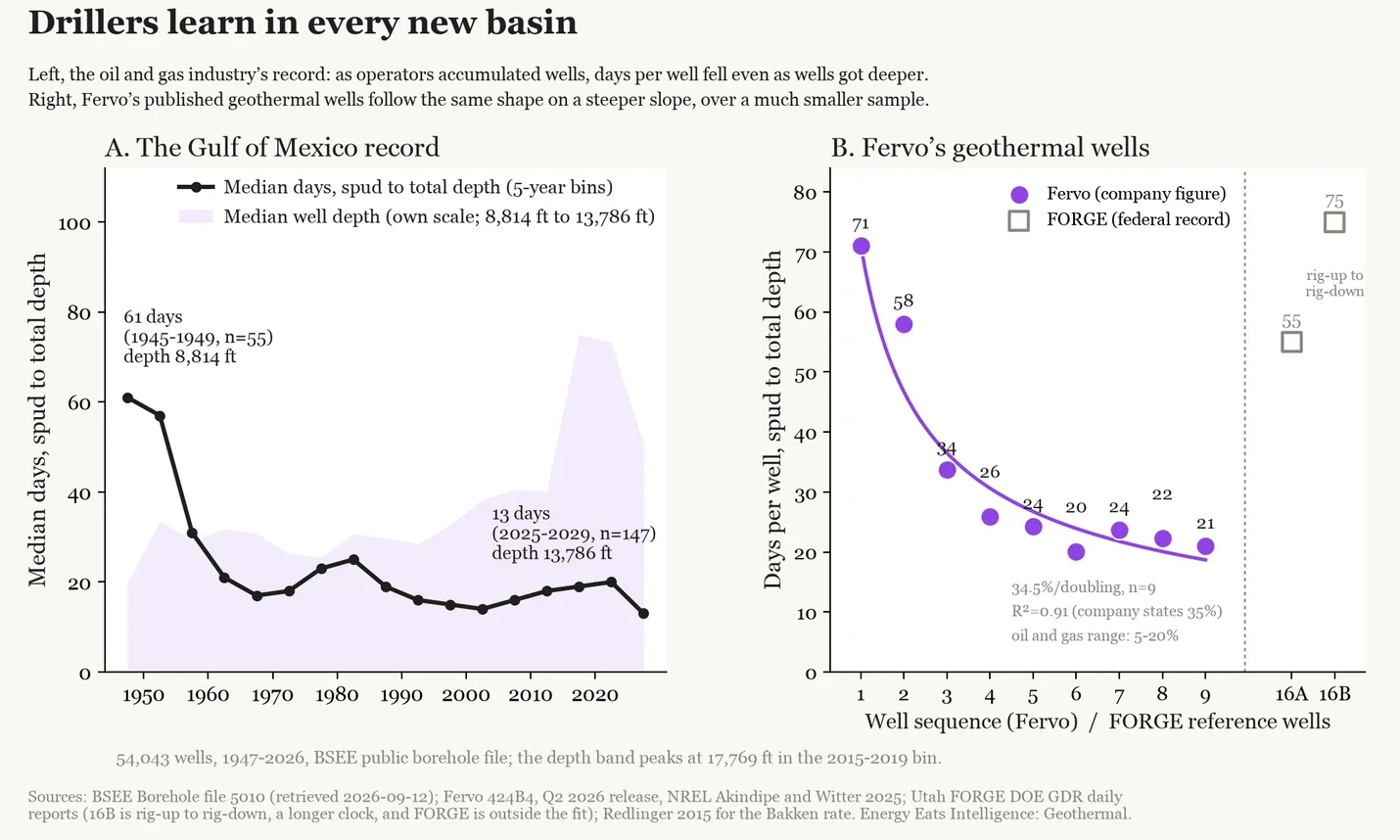
Two Amoco engineers, Brett and Millheim, showed in 1986 across more than 2,000 wells in 30 areas that days per well fall with each successive well in a new area, on a curve whose steepness depends on how new the area is to the crews. Bakken operators improved about 5% per doubling of experience; shale programs are generally put at 5 to 20, on thinner evidence. The largest public record is the federal borehole file for the Gulf of Mexico: 54,043 wells since 1947, in which the median well took 61 days in the late 1940s and 13 among the wells spudded in 2025 and 2026, while the median well grew 56% deeper. Fervo’s nine published wells sit on the same curve, steeper: from 71 days for its first Nevada well in 2022 to 21 days for a 19,448-foot well in 2026, a 35% improvement per doubling on our fit to the nine published wells. That matches the company’s own stated rate and flatters it, since the ninth was drilled after some 20 unpublished Cape wells. That is above the oil-and-gas range, as a first-of-a-kind program of nine wells should be; the Gulf rate is measured over thousands. Fervo’s published cost per foot fell 64% from its first well to its eighth over the same run. Whether the curve travels to new projects is not settled. A 2026 study of the capital cost of all 514 geothermal plants built since the 1950s found that it rose with cumulative deployment worldwide and fell in the United States, at 18% per doubling, and concluded that geothermal learning is local. In its reading, engineered and closed-loop reservoirs are unlikely to change the global picture, while the American record supports the cost declines American developers project. The next result for this step is the same curve in hotter rock, which Fervo’s third well design, built for 238°C rock, is now drilling into, and for any non-contact method, a first well a plant can use.
Case and complete the well
A traditional geothermal well is a steel pipe cemented into hot rock. The pipe, the cement between it and the rock, the seals at every joint, and every tool lowered through it have a temperature above which they fail, and the whole assembly has to hold pressure for decades while hot, chemically active fluid moves through it. No commercial well has yet gone hot enough to need new casing, so this step has had the least capital so far; the research wells that did go that hot show what fails.
Standard-rated oilfield downhole tools work to about 175°C. Cape Station’s rock runs from about 200°C in the first wells to 238 in the latest design, and Hephae Energy Technology has run its 210°C measurement tool there repeatedly in 2026. The hottest completions hardware in this record is a sliding sleeve operated above 300°C that Halliburton installed and opened in Mazama Energy’s well at Newberry, in a 331°C reservoir. In the band from 200 to 350°C the steel and cement are routine, since conventional fields have run there for decades; the tools, seals and completion hardware are qualified only piece by piece, as Hephae’s and Halliburton’s were. At 350 in acidified, high-chloride brine one failure is on record, premium nickel alloys corroding and cracking in laboratory tests. Above 374°C no casing, cement or completion has been qualified for sustained production, though IDDP-1’s wellhead did hold in 452°C steam.
Why the pipe fails. It is not that steel melts. Ordinary casing keeps most of its strength at these temperatures: the yield strength of the common K-55 grade falls from 388 to 359 megapascals between room temperature and 371°C, and the stronger L-80 grade from 632 to 484. The problem is that a casing cemented into rock cannot expand. Steel grows about 12 millionths of its length for every degree, and a pipe held fast while it is heated by 300°C carries a stress of roughly 700 megapascals (our arithmetic, at a stiffness of 200 gigapascals), well above the yield strength of either grade, so the pipe yields in compression as the well warms up. When the well cools, in a shut-in or a quench, the same pipe goes into tension and the joints part or the string buckles. A 2022 analysis calls this “mechanical overload of casing string due to constrained thermal expansion” the single most common failure in high-temperature geothermal wells, and Iceland’s geological survey, which has spent a decade on couplings that let the casing move, says the stresses on heating “in most cases far exceed the yield strength of the steel”. IDDP-1 is the case: it flowed 450°C steam for two years, and its casing collapsed not while hot but when the well had to be quenched after its surface valves failed. Cement is the second half. Geothermal cement is Portland cement with about 40% silica flour added to keep its strength at geothermal temperatures, and it still suffers acid and carbon dioxide attack; at 400°C it has to survive the same cycling as the pipe without cracking or letting go of it. Add the acid brine, and elastomer seals that fail long before the steel does, and the list of what must be qualified is short and definite: a pipe or a coupling that absorbs the expansion, a cement that holds, seals and tools that work at temperature. The couplings exist and went into a Nesjavellir production well for testing in February 2025; none of it has been proven over years of service.
So the spending has gone elsewhere in technology development: of $534 million in federal geothermal research awards from 2015 to 2026, $466 million of it assignable to one of the five steps, $10 million went to casing and well integrity. Kakkonda in Japan reached more than 500°C in 1995, Iceland’s IDDP-2 reached 426°C at 4.66 kilometers, Venelle-2 in Italy logged 514°C. Kakkonda found nothing to produce: below about 380°C its granite had passed the brittle-ductile transition and held few fractures and no permeable zones, and the rock at 500 was drilled through and did not flow. The Icelandic wells were stopped by hardware, IDDP-1 by its valves and then its casing, IDDP-2 by lost circulation and a blockage; Venelle-2 by both, tools rated below the rock’s temperature and rock that held no fluid. A 2018 review of the 20 or so wells that had reached supercritical conditions found casing failure under thermal load the most common way they ended. They were drilled with ordinary rigs, as the Drill step describes; the trouble came from the well itself. Venelle-2 took cement and tools rated to about 450°C into rock above 500. A superhot casing and completion is still materials development. The result that would settle it is a casing and completion surviving a year above 400°C.
Extract the heat
How the heat comes out depends on the architecture. In a closed loop the design’s whole problem is contact area, which Eavor answers with many long laterals and XGS by making the rock around one well conduct better. Every design has to show how fast the rock cools at the rate the plant needs.
Los Alamos circulated a fractured reservoir at Fenton Hill, New Mexico, at 3 to 10 megawatts of heat in tests that ended in 1995. The current generation has two records so far. Fervo’s longest published test at Cape is a single well triplet run for 30 days in 2024, reported as 8 to 10 megawatts gross at about 100 kilograms per second and a produced-fluid temperature of 195°C; the electricity figure is Fervo’s conversion from measured heat and flow rather than a meter reading. On October 1, 2026, Fervo reported that the first of Cape’s three 33-megawatt units had reached commercial operation the day before and was producing 33 megawatts net. That too is the company’s figure; the metered record starts when the Energy Information Administration publishes October’s output, in December. The second record is longer and comes from the state rather than the company. Nevada publishes monthly production for every geothermal well it permits, and Fervo’s Project Red wells are in that file. From December 2023 to March 2026 the producer ran above 5 kilograms per second in 21 of 28 months at a mean of about 32, with a five-month outage from December 2024 to April 2025, and its wellhead temperature held between 336 and 347°F, 169 to 175°C, throughout. That is half of Red’s own test rate and about a third of Cape’s design rate, and over those months the rock did not measurably cool; Fervo’s own finer record, in its April 2026 update, shows no decline for more than 500 days and then a fall of about 2.5°F.
The longest published run at Cape’s design rate is that 30-day test, so we built a model of a Cape well pair from the standard analytic solution for heat sweep between parallel fractures, published by Gringarten, Witherspoon and Ohnishi in 1975. It is the optimistic end of the published range, so its curves are upper bounds, and two of its inputs (fracture spacing and injection temperature) aren’t in the public record and are assumed. On the fracture area Fervo infers for a Cape well, a pair at 100 kilograms per second sees its produced temperature fall a tenth of the way toward the injection temperature by year seven. In this model, holding the 1% annual decline written into the Corsac contract needs 1.4 to 1.7 times that area, or roughly twice that if the published area counts both faces of the fractures; the comparison takes the decline in heat to show up one for one in electricity. Fervo’s own calibrated three-dimensional simulation is beyond what ours can do, and its published curve of a produced temperature falling from 220 to 180°C over 30 years is itself a decline of a little under 1% a year in deliverable heat. Nothing public settles it either way yet, and Cape’s own production data start arriving in December. For scale, 15 of 23 producing Nevada fields are cooling more than 1°F a year, and the fleet has financed that for decades by drilling replacement wells. Blue Mountain, Nevada, is the documented case. Its owner told investors in 2011 that reinjected brine was cooling the reservoir faster than forecast and that output might fall faster than the modeled 2.5% a year and the contract’s 3% allowance, and the plant’s output fell from 32.6 average megawatts that year to 19.8 in 2025.
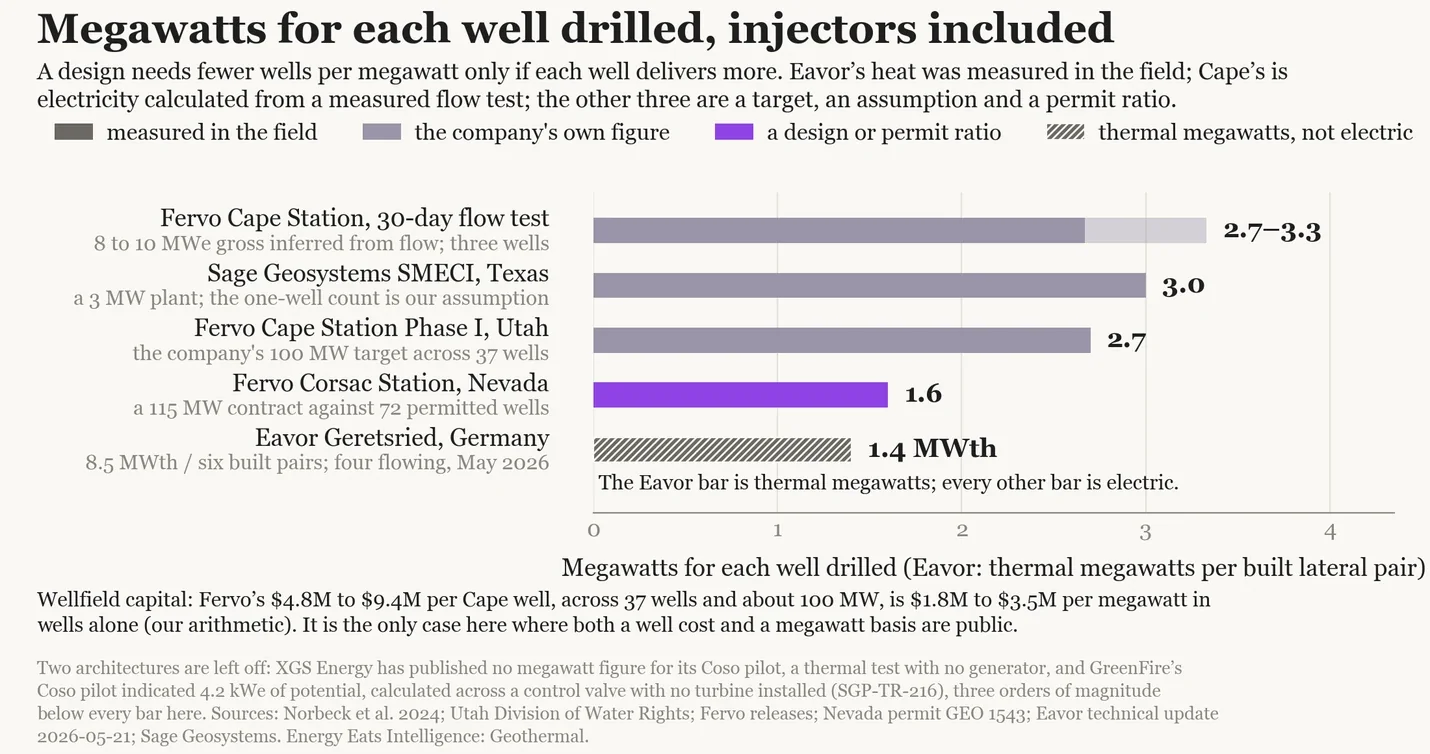
The other developers are running their own tests. Sage Geosystems’ 3-megawatt single-well plant in Texas sold first power in the second quarter of 2026. Mazama connected two wells in the same 331°C reservoir in October 2025, the hottest enhanced-geothermal connection to date as of September 2026. Eavor’s closed loop at Geretsried came online in December 2025 and, with six of the first loop’s 12 pairs built and four flowing, produced about 8.5 megawatts of heat in May 2026, more per flowing pair than its design basis, through a plant converting at about 4%. XGS ran its single-well system at Coso within 2% of its model and has a 150-megawatt development agreement with Meta for a New Mexico plant by 2030. The chart below shows what has been published, with the assumptions labeled.
Convert it at the surface
The share of the heat a plant can turn into electricity is set by how far the fluid’s temperature sits above its surroundings, so a binary plant at 150°C converts roughly a tenth of the heat it receives and the fraction rises with temperature. This is the enthalpy curve of Part 1 seen from the turbine’s side. Below about 200°C a binary plant boils an organic working fluid off the brine and runs it through a turbine; above that, flash steam does the work directly. Turboden supplied the binary equipment for Cape’s first phase and was selected for the second, for which Baker Hughes supplies the turboexpanders. A newer approach builds the plant in a factory: Critical Energy is building 2.5-megawatt containerized modules with its own turbomachinery, with a first plant targeted for 2027. Gross and net differ by the power the plant spends on its own pumps and fans, about 15 to 30%. The federal generator inventory registers Cape’s three first-phase units at 43 megawatts nameplate and 30 megawatts of net summer capacity each, the second figure carrying both that parasitic load and the summer derate of an air-cooled plant. Above the critical point, a turbine and heat exchanger for supercritical geothermal fluid exist as designs and as an analogy to supercritical coal. No geothermal well has yet fed one.
Part 3. Contracts, prices, financing and cost
What it is paid
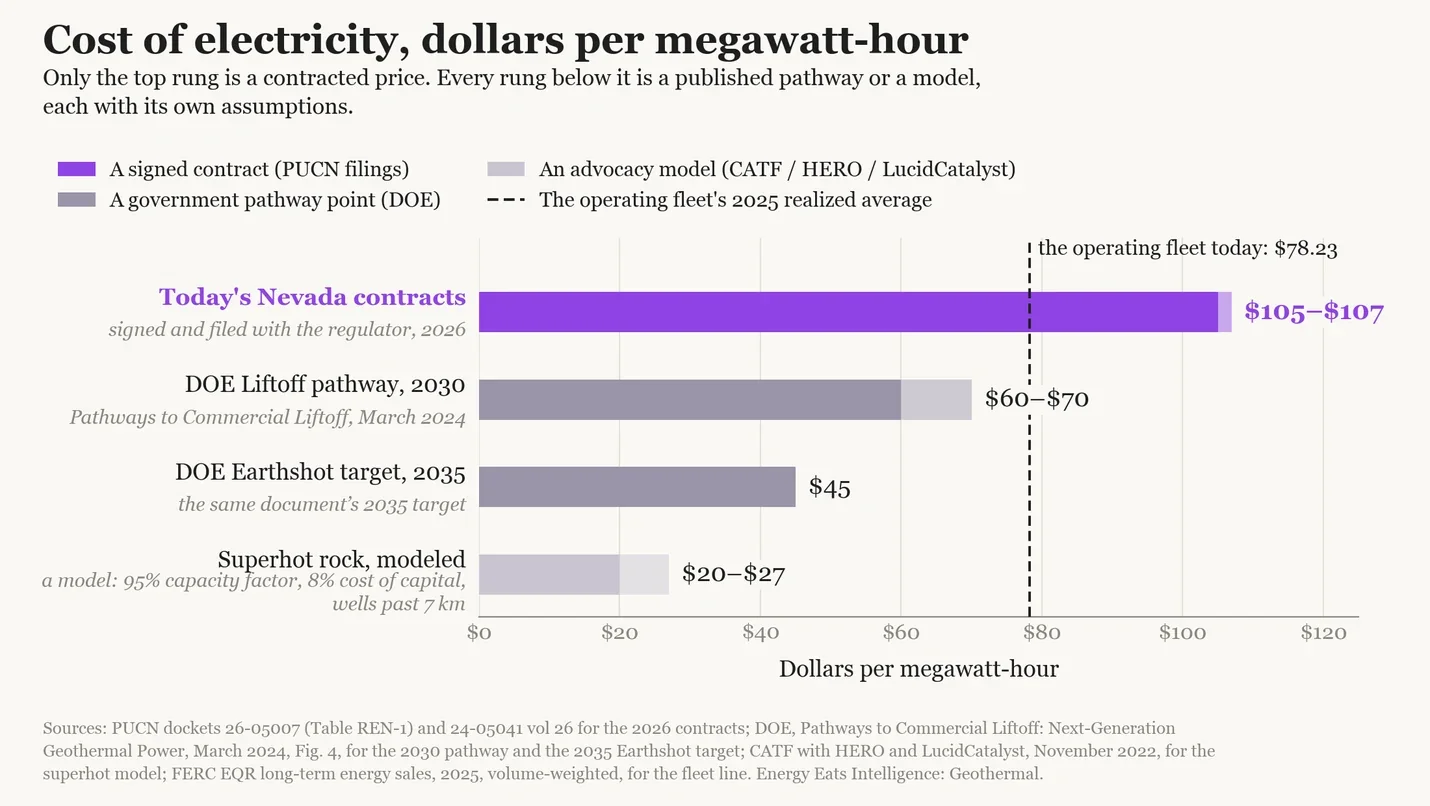
Nevada’s Public Utilities Commission has published Fervo’s Corsac contract in full: $107.00 a megawatt-hour, flat for 15 years. The same utility’s 2026 resource plan prices Ormat’s new conventional portfolio for Google at $107, Zanskar’s for Amazon at $105, and the hyperscalers’ own solar-plus-storage at $105 to $108 levelized. The operating fleet’s long-term contracts averaged $78 in 2025. So enhanced geothermal sells today at about the price of new conventional geothermal and of the utility’s own levelized estimate for solar-plus-storage, a different product, and well above what the existing fleet earns.
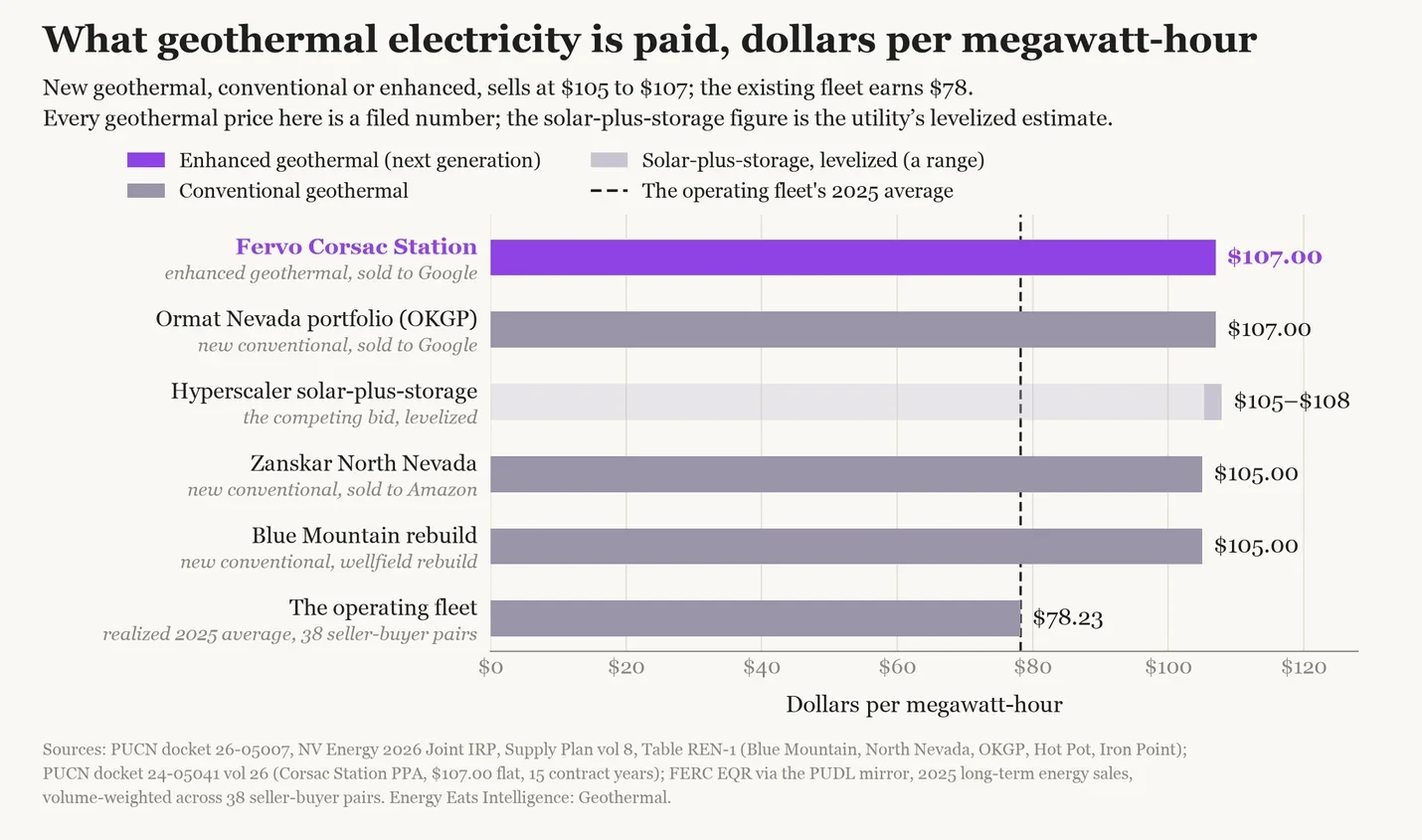
Older contracts are public too, and they run from $52.50 to $128. Idaho Power agreed $52.50 a megawatt-hour, escalating, for Raft River in 2007 and $96 in the first year, $117.56 levelized, for Neal Hot Springs in 2009. Ormat’s Nevada plants sell to Los Angeles at $75.50 flat under a 2017 contract and to NV Energy at $85.58 escalating under a 2015 one. California’s community power agencies, the same kind of buyers as in the opening paragraph, signed geothermal contracts in 2023 at an average of $128 including renewable credits, the highest disclosed American price. Most contracts stay private: the 2025 US Geothermal Market Report lists 26 geothermal contracts signed since 2021 and a price for two of them.
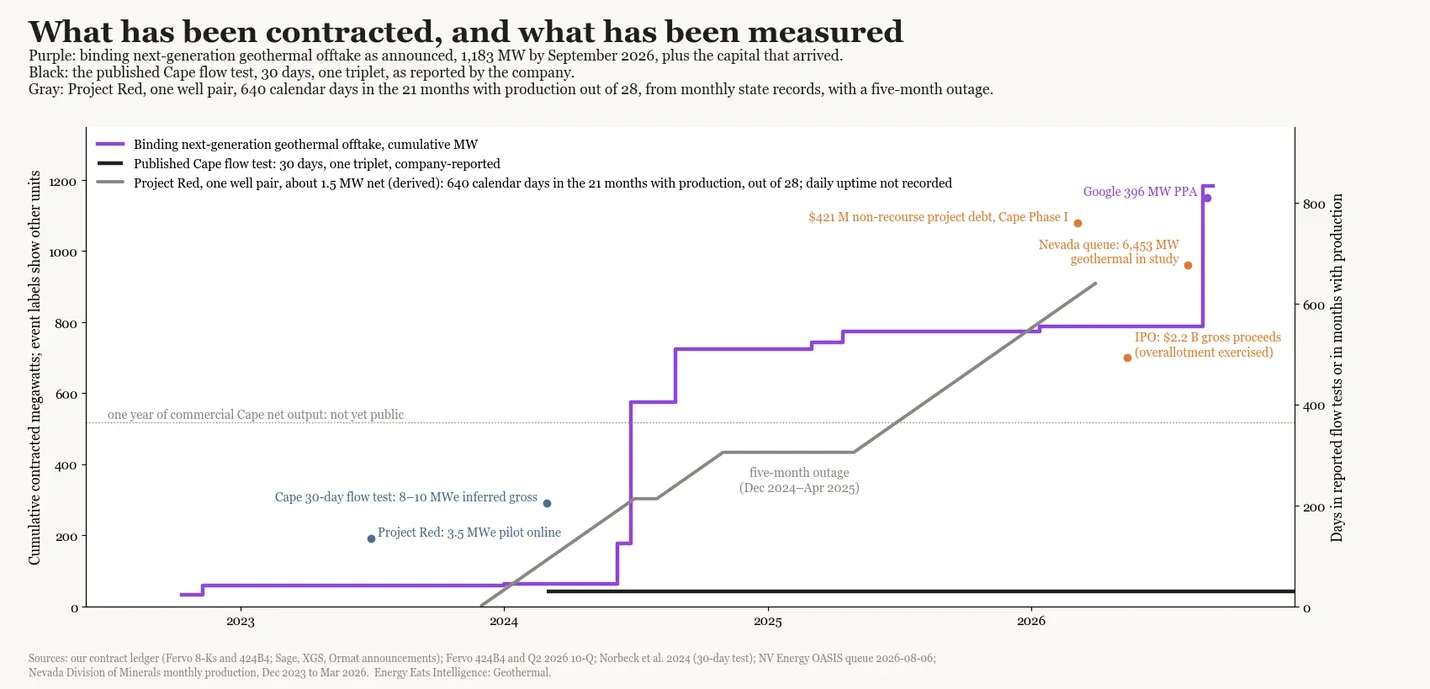
By our count from filings and dockets, 1,183 megawatts of signed offtake exist for new American geothermal plants: 1,017 of them Fervo’s enhanced-geothermal contracts as we itemize them (the company’s own binding total runs about 37 megawatts higher), 150 Sage’s with Meta, and two small ones. That is before counting the two Nevada portfolios sleeved to Google and Amazon, signed in 2026 and awaiting the commission’s approval. The chart sets those megawatts, and the capital that arrived with them, against the operating record that exists so far.
How a first plant gets financed
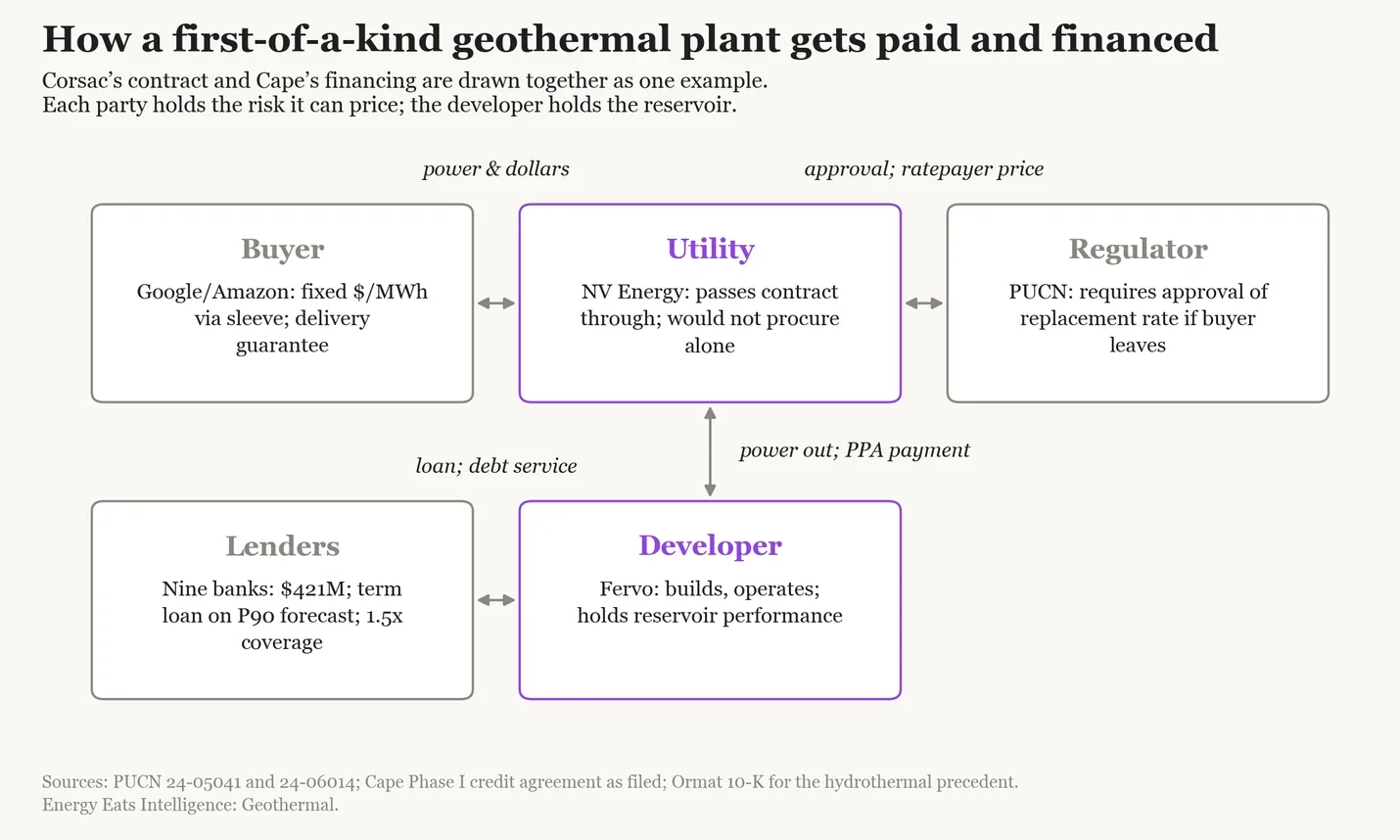
The buyer takes a fixed price and a delivery guarantee. The utility passes the cost through to Google but stays bound to the plant’s contract if Google’s agreement ends; NV Energy’s witness, Janet Wells, testified that without Google’s agreement the utility “would not have brought the geothermal resource for approval given the price premium,” and no buyer quantifies the value of firm power in the Nevada filings we read. The regulator approves it and protects ratepayers, in Corsac’s case by requiring a new price if Google’s agreement ends. The lenders, nine banks in Cape’s $421 million facility, lend against a production forecast: the loan converts to a term loan when the drilling and completion tests are done, is sized to 1.5 times debt service on a conservative forecast, and pays for replacement wells from a reserve. Blue Mountain shows the debt and the equity coming out differently: the federal loan guarantee was repaid in full even as output fell by about 40%, and the sponsor handed the plant to its mezzanine lender in satisfaction of $97 million of debt, receiving $500,000. The developer builds and operates the plant and carries the reservoir risk. Ormat has financed sixteen hydrothermal plants on the same architecture; Cape applies it to an engineered reservoir whose operating record does not yet exist.
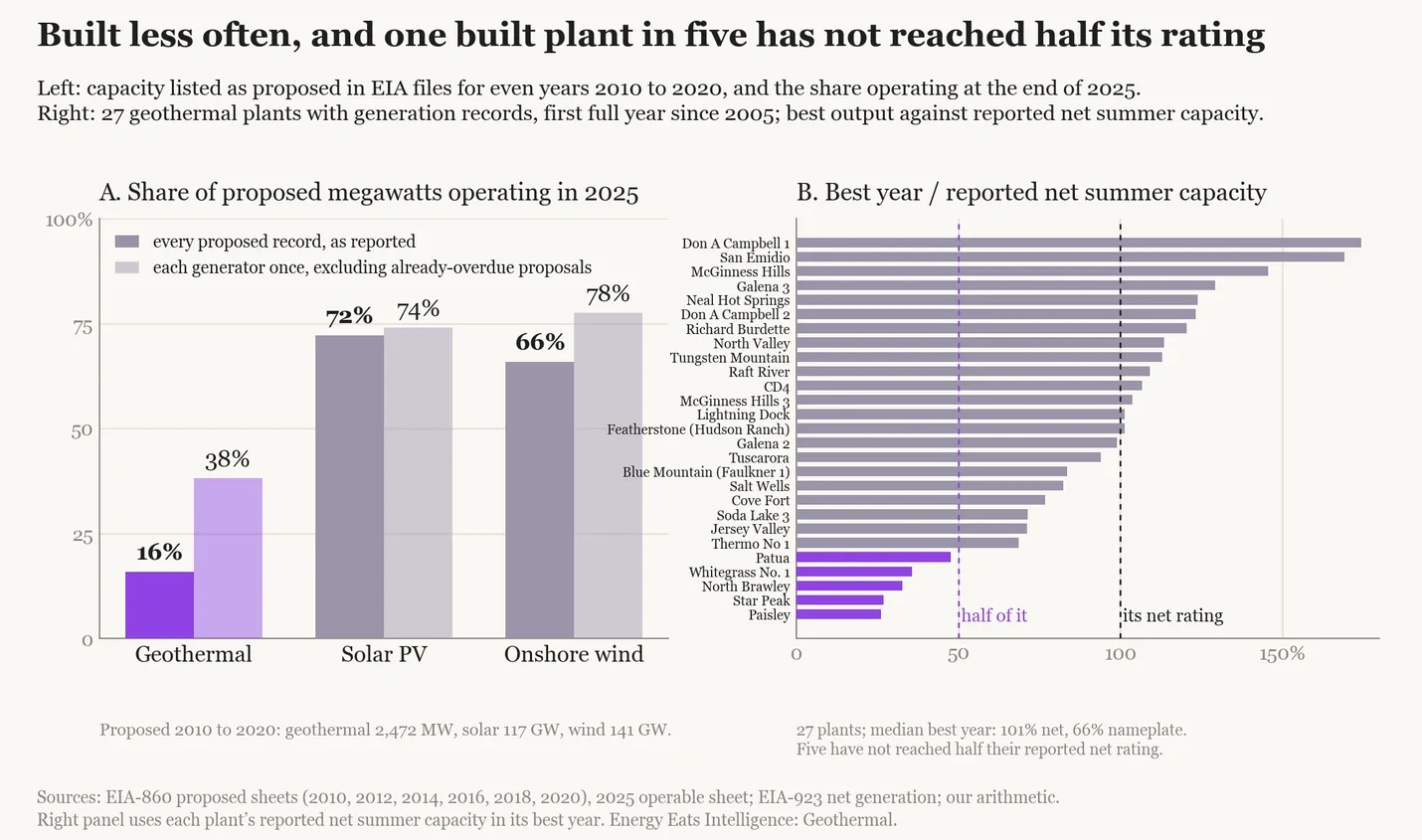
Lenders are pricing how well a plant’s output can be forecast before its wells are drilled, and public filings put four numbers on that: the spread between wells in one field, the odds on a first well, the share of proposed plants that get built, and what the built ones then produce. In a producing Nevada field, eight wells in ten deliver between 0.6 and 1.4 times the field’s average, and the spread depends on the field more than the well: McGinness Hills’ wells scatter 6% around their average, Soda Lake’s 80 (our arithmetic from the state’s well-level production file). The first well in a new field succeeds about half the time in the International Finance Corporation’s study of 2,613 wells. Of the geothermal capacity listed as proposed in the Energy Information Administration’s files for even years from 2010 to 2020, 16% was operating at the end of 2025, or 38% counting each generator once and dropping proposals already past their planned date, against 72 to 74% of proposed solar and 66 to 78 of wind. The geothermal plants that were built arrived no later than solar or wind plants do and at or above their proposed nameplate. Their output since then has spread widely. Across the 27 built since 2005, the median plant’s best year was 66% of nameplate, the gross rating in the announcements, and 101% of the net summer capacity it reported that year; net summer capacity runs near two thirds of nameplate for a binary plant, as with Cape’s 30 against 43 megawatts in Part 2. One plant in five has not reached half of that net rating in any year (our arithmetic from EIA-860 and EIA-923). The last public cohort of developers, Nevada Geothermal Power, Raser Technologies, U.S. Geothermal and Ram Power with the companies it absorbed, listed in Toronto and New York between 2005 and 2012, announced 113 megawatts at the six plants it built, which averaged 69 megawatts in 2025. A privately financed plant of the same vintage, Patua, announced 60 megawatts and averaged 9 in 2025, and the one geothermal pure-play sold whole went to Ormat with 55 megawatts under contract and 38 of net generating capacity.
Getting the power to the buyer is its own set of contracts. Cape Station’s interconnection agreement was signed in June 2024, and its loan documents name two transmission providers, Milford Gen Lead and the Los Angeles Department of Water and Power, between a plant in Utah and buyers in California.
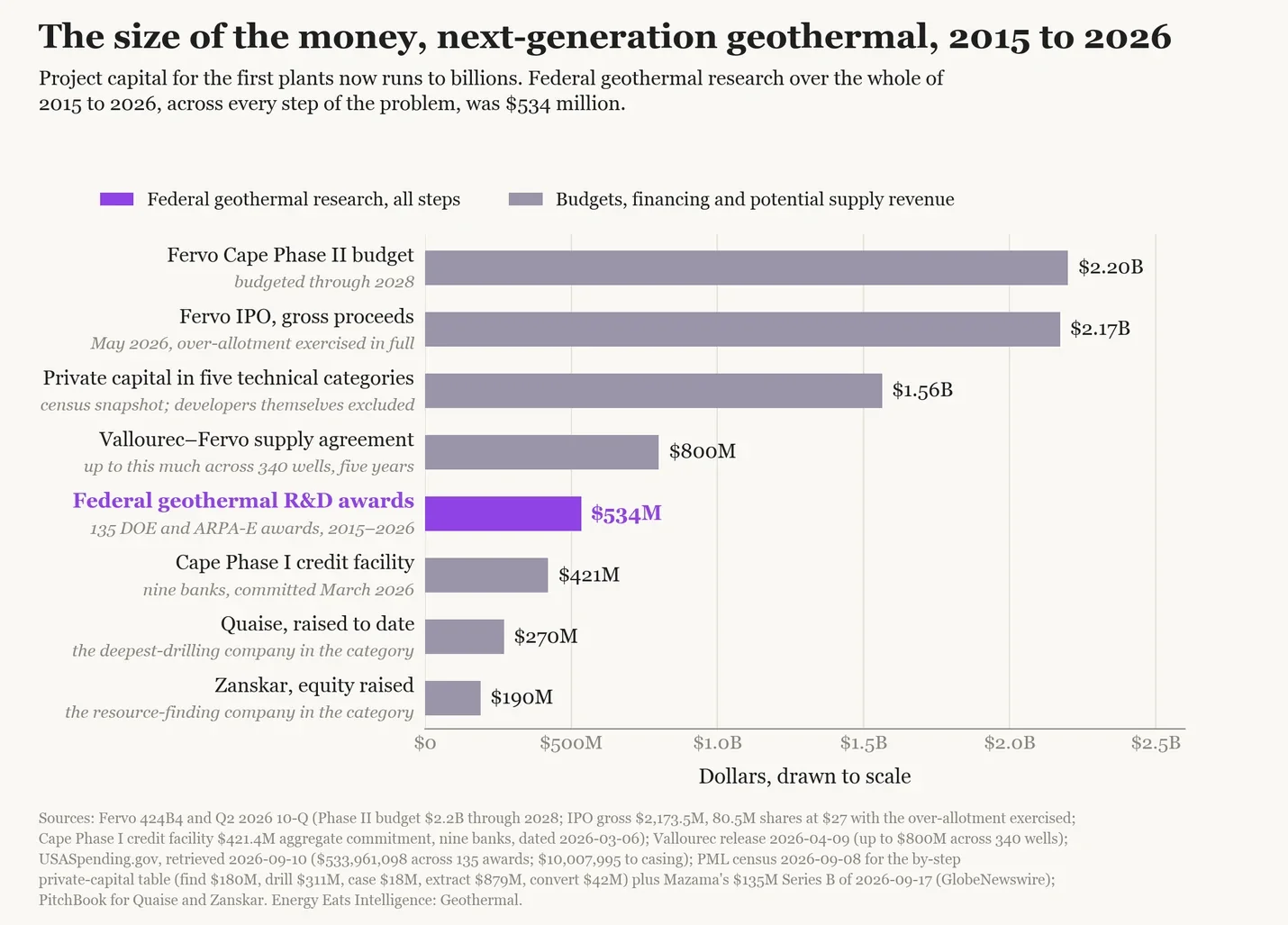
Fervo’s public offering raised about $2.2 billion, its second phase at Cape is budgeted at about the same, and its five-year casing supply agreement with Vallourec could generate up to $800 million. The $2.2 billion second-phase budget is about four times the federal geothermal research awards of 2015 to 2026, which the chart sets beside it; the chart’s bars are budgets, financing, a supply agreement and awards, which overlap and do not add.
What it costs, and the path down
The cost of a geothermal megawatt-hour comes down to a short list: what each well costs, how many wells a megawatt needs, how efficiently the plant converts heat, how many hours a year it runs, the cost of capital, and the tax credit. The investment tax credit is worth about $28 a megawatt-hour on Fervo’s own Phase II capital-cost target, a quarter of the contract price (our arithmetic: a 30% credit on $5,500 a kilowatt, spread over 15 years of output at a 78% capacity factor and an 8% real discount rate). The July 2025 tax law kept geothermal on the credit’s original schedule to 2033.
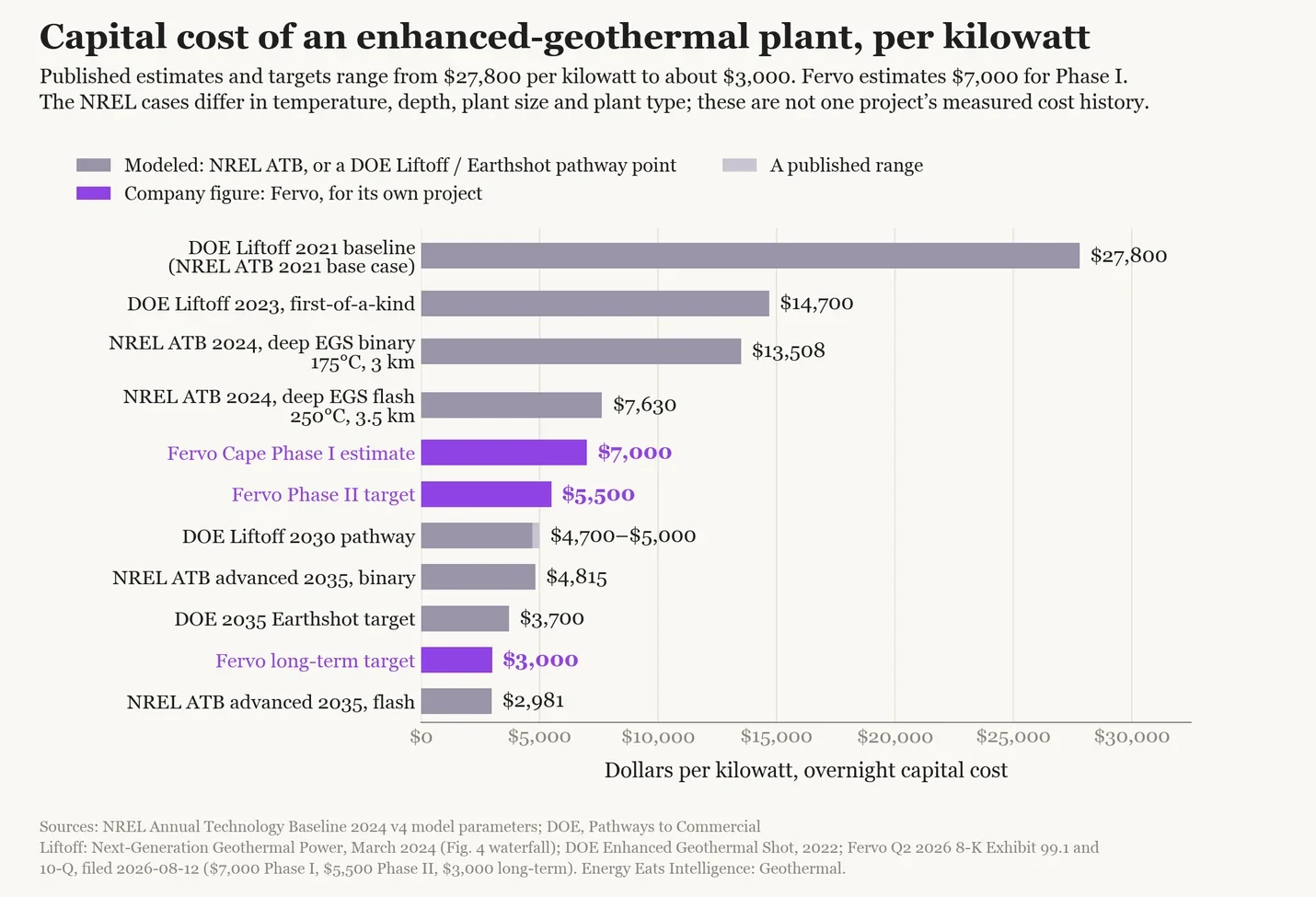
Capital cost first. The chart puts the public estimates on one axis. The National Renewable Energy Laboratory’s baseline for an enhanced-geothermal binary plant at 175°C and the Department of Energy’s first-of-a-kind figure both sit near $14,000 a kilowatt; Fervo’s own figure for Cape’s first phase is $7,000 and its target for the second is $5,500; the Department’s pathway falls below $5,000 by 2030. Drilling faster moves a plant down that chart; the Department credits the learning curve of Part 2 with cutting the cost of a well from $13 million to under $5 million between the first two American pilots. Temperature moves it too. NREL’s flash plant at 250°C costs $7,630 a kilowatt against the binary plant’s $13,500; the two differ in depth and size as well, but a flash plant is possible only at the higher temperature.
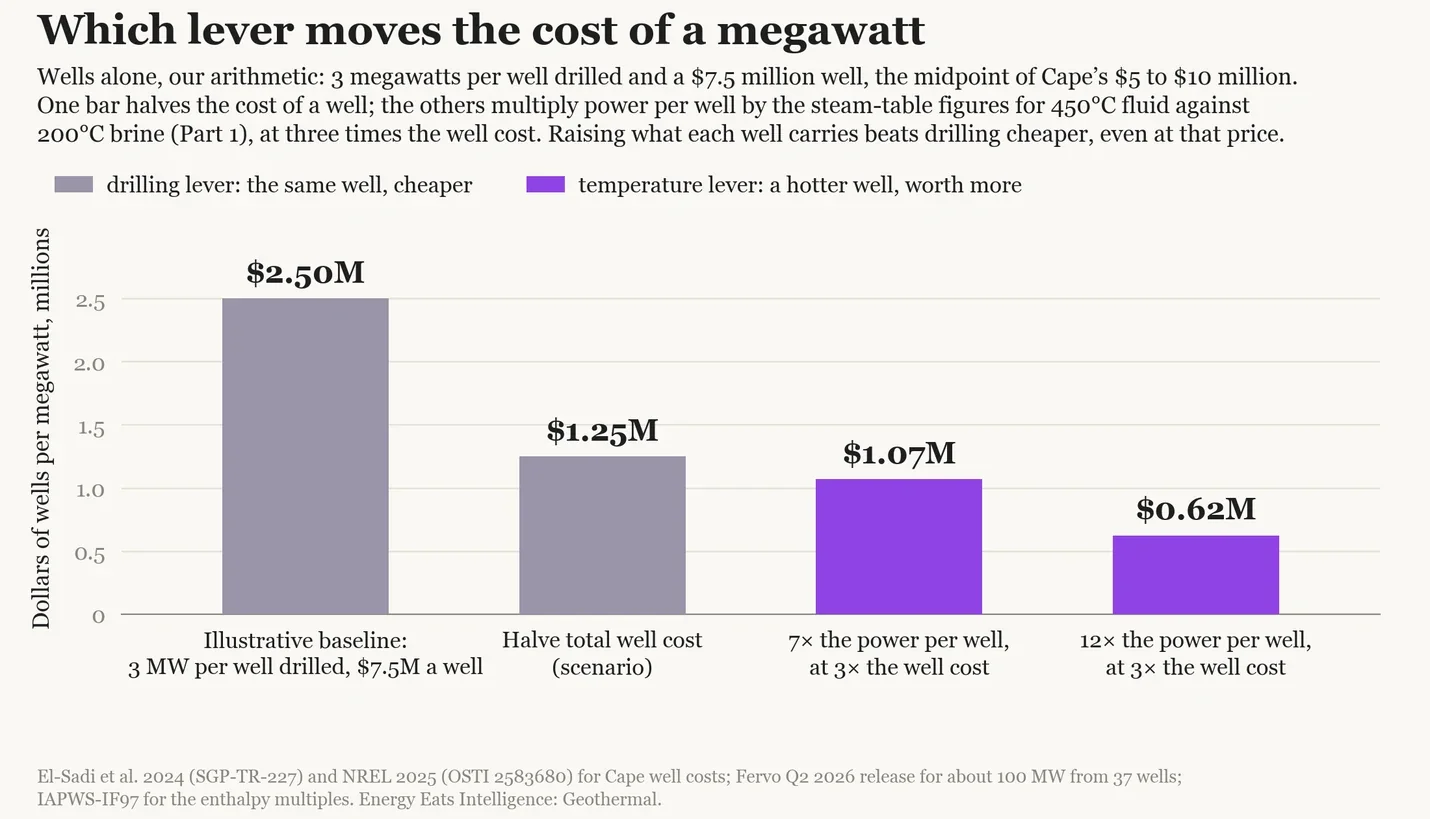
Then the cost of electricity. Today’s contracts are the top rung. The Department’s pathway reaches $45 a megawatt-hour by 2035. Below that sits the superhot estimate: $20 to $27, modeled in 2022 by the Clean Air Task Force, the Hot Rock Energy Research Organization and LucidCatalyst on a 95% capacity factor, an 8% cost of capital and a well-cost curve extrapolated past 7 kilometers. The rungs differ mostly in how many wells a megawatt needs, and architecture and temperature set that. Cape’s first phase, the company’s 100 megawatts target from 37 wells, works out to about 3 megawatts for every hole drilled, injectors included. At superhot temperatures the enthalpy curve of Part 1 means one well does the work of several conventional ones. Each is deeper and dearer, about $23 million a well in the Clean Air Task Force’s 6-kilometer case against roughly $5 to $10 million for Cape’s wells, so the saving comes from drilling fewer of them. Our own short calculation compares the two levers. Take a Cape well at the company’s rounded target of 3 megawatts and a midpoint well cost of $7.5 million: the wells alone are about $2.5 million for each megawatt. Halve the cost of a well and that falls to $1.25 million. Multiply the power each well carries by seven, and it falls to about $1.1 million even if each well costs three times as much; by 12, to about $0.6 million. The industry has been drilling faster, and it works. Raising what each well produces moves the cost further, and temperature is the way to raise it. It depends on three things not yet done: flow at Cape’s rate from superhot rock, where the best flow measured so far, at IDDP-1, is 50 kilograms per second, half of what Cape’s test well flowed; a casing that survives above 400°C in production; and a plant fed by a supercritical well.
Who keeps the saving when drilling gets cheaper depends on the contract. Fervo’s existing agreements, $7.2 billion of contracted revenue backlog, are priced “generally fixed for the duration of the contract”. The roughly 70% fall in its cost per foot since 2022 on the company’s own figure (64% across the eight wells it has published) accrues to Fervo’s margin under those fixed prices, as any overrun would, until the contracts roll. The framework agreement covering up to three more gigawatts for Google, signed in March 2026, prices instead, in the prospectus’s own risk factors, on “a cost-plus targeted return basis, subject to caps, floors, and escalating discounts on expansion projects”, with audit rights over Fervo’s costs. Cost reductions on projects contracted under the framework would pass in part to the buyer; how much depends on the return, the caps, the floors and the discounts, none of them disclosed. The framework is non-binding and lapses in March 2028 without a definitive contract.
Part 4. What this adds up to
Two conclusions follow.
First, build what works, and keep building it, the natural reservoirs still being found as well as the engineered ones. Enhanced geothermal has sold at about the price of its alternatives and has borrowed on a structure lenders use for conventional plants. Its hazards are bounded, it has no fuel to buy, and its cost has fallen across the wells it has published. The 1,183 megawatts already contracted are a quarter to three fifths of the Department of Energy’s Liftoff pathway of 2 to 5 gigawatts by 2030. Every plant built trains the crews, suppliers and lenders a hotter plant will need. The United States drilled 54,302 oil and gas wells in 2008, and fractured 263,859 between 2000 and 2014; American next-generation geothermal has drilled a few dozen wells in total. Fervo’s learning rate of 35% per doubling, fitted to its nine published wells, is above the 5 to 20% measured in shale plays, though the sequence omits the Cape wells drilled between them; those nine are three doublings, against the eighteen the shale industry has run through. A Cape well now costs what a shale well costs; the industry has drilled too few of them. People in the industry draw opposite lessons from shale. Fervo and the drilling-led companies take from it that well costs fall when the same crews drill the same well hundreds of times, and that geothermal has barely started counting. Zanskar takes from it that the old conventional oil fields still produce more cheaply than the best shale acreage after 20 years, and expects the same of natural geothermal reservoirs against engineered ones.
Second, fund the steps a superhot plant needs. The casing, tools and conversion categories in our tally have had about $36 million of federal awards and $60 million of disclosed private capital between them, about $96 million, against $1.39 billion of federal awards and disclosed private capital for extracting the heat: 7 cents for every dollar that went to the reservoir. That figure includes the federal Utah FORGE laboratory, some of whose work is drilling and completions rather than reservoir, and excludes Fervo’s public offering. Those steps are a casing and completion that survive above 400°C, tools that work there, and a surface plant fed by supercritical fluid. The count includes only companies whose product is casing, completions or surface conversion, so developers such as Quaise and Mazama sit under drilling and the reservoir. The chart shows where the disclosed capital of the last decade went: to finding, drilling and the reservoir, the steps that stood between a 200°C plant and its first power. Those steps now have results. The tally counts companies by their product, so casing or tool work done inside a developer does not appear in it. The one published superhot cost model we know of, the Clean Air Task Force’s, puts the result on the bottom rung of Part 3’s ladder. Its authors name two gaps, well cost past 7 kilometers and conversion efficiency at supercritical conditions, and the enthalpy arithmetic itself deserves an independent treatment. Nobody has argued against funding these steps. No commercial well has needed them yet.
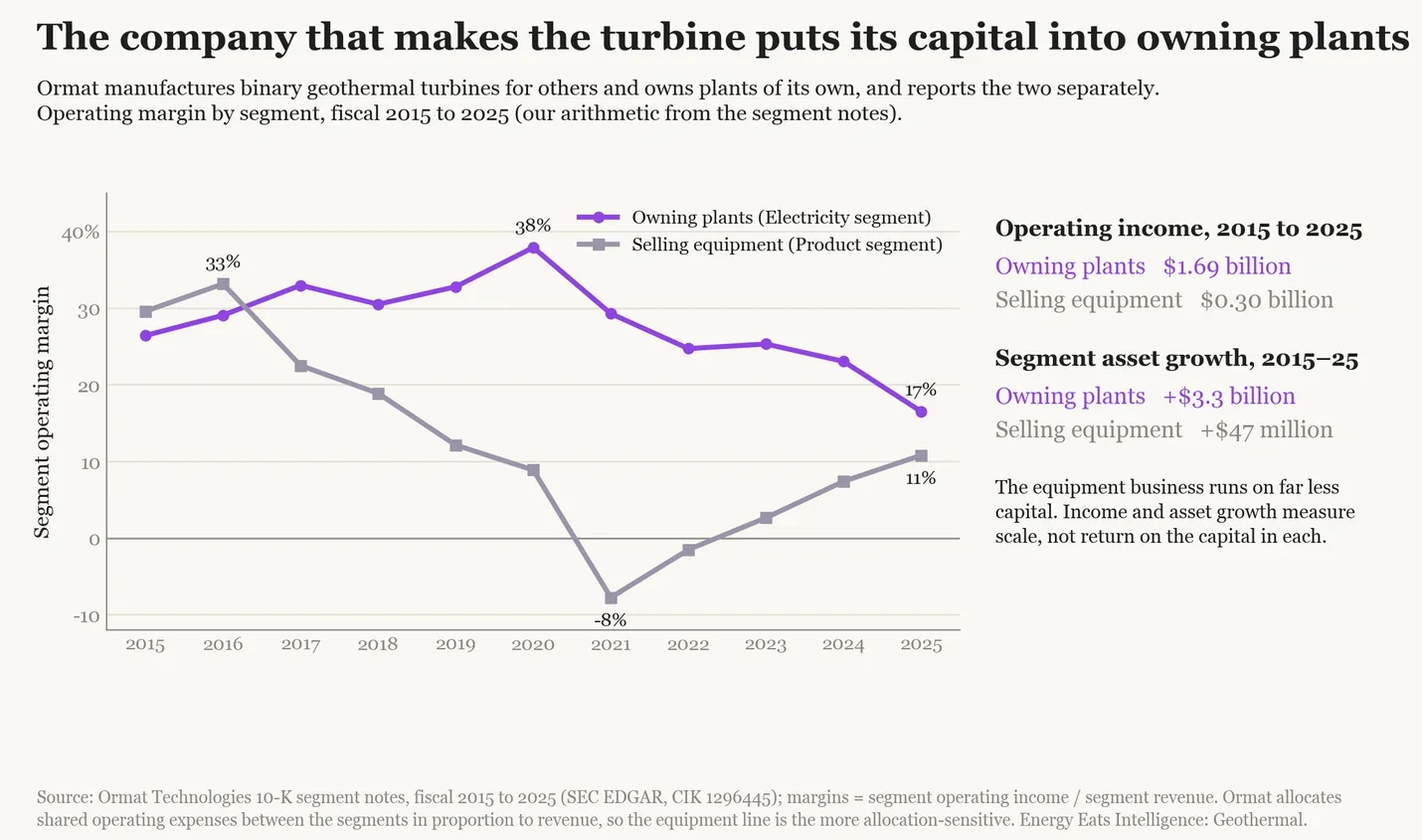
There is a second reason, from the economics of invention. When an idea is hard to keep to yourself, as drilling and completion know-how is, the value goes to whoever owns what the idea needs in order to be used: the leases, the water right, the interconnection, the contract and the balance sheet, what economists call complementary assets. Ormat builds binary geothermal turbines for others and owns plants of its own, and reports the two separately: from 2015 to 2025 owning plants earned it $1.69 billion of segment operating income and selling equipment $0.30 billion, 85% from owning (our arithmetic from its segment notes; the chart shows the margins by year). Over the same years its reported segment assets grew by $3.3 billion for owned plants and by $47 million for equipment; these are measures of scale, not of return on the capital in each. Fervo’s prospectus lists what a developer owns: 595,900 acres of leases, water rights, interconnection agreements and the $7.2 billion contract book above, no manufacturing assets, and rigs, casing and turbines bought from Helmerich & Payne, Vallourec, Turboden and Baker Hughes. Bonus bids at federal geothermal lease sales rose from about $10 an acre in 2023 to about $180 in the first eight months of 2026 (our tally of BLM results, parcels that sold), and the August 2026 sale beside Cape Station set a record parcel bid of $1,207 an acre, with land companies among the largest bidders. Nearly every company in this paper that has raised venture-scale capital and reached a plant now develops plants, and Quaise, which has not yet reached one, raised its latest round to build one. Eavor says its aim has always been to license, and the oilfield service majors sell tools and own no plants. Each of the three superhot steps is a product sold at a supplier’s margin to whoever owns the well. None exists yet as a product qualified for sustained superhot production; their natural sponsors are the developers who would use them and the public programs that fund what developers cannot capture.
What that money should buy, in the order the wells will need it: casing, cement and seals qualified for 400°C in acid brine, and the test facilities to prove them over extended periods of time; downhole tools and sensors that work above 300°C; flow tests at depth in superhot rock; a supercritical turbine and heat exchanger built and run on a real well; and drilling programs, contact or non-contact, that take the learning curve beyond 5 kilometers and 400°C. Utah FORGE already publishes its wells in full, 133 terabytes of it, under a license that lets anyone use the data; results from the federally supported wells at Cape sit under the repository’s standard embargo into 2029. Releasing them sooner would give the industry data it does not have to drill for. Each of the five is the kind of qualification program the oil industry ran for deepwater and the nuclear industry ran for its materials, and each is small against the project capital now flowing to the first plants.
Cape’s first unit reached commercial operation on September 30, 2026, a day before its contract date, at a company-reported 33 megawatts net; its first full month of output, October, reaches the public record about two months later, in December 2026: that is the first number to watch. Units 2 and 3 are due by January 1, 2027. Twelve months of output from the first unit’s wells at design rate can exist by October 2027; for all three units, January 2028. Cape Phase II is due in June 2028. Corsac, Ormat’s Google portfolio and Zanskar’s Amazon portfolio are due in 2030. Iceland’s IDDP-3 is scheduled to start drilling at Nesjavellir in the fourth quarter of 2026, Mazama’s next project after that well, Ceres, is scheduled for the same quarter, and New Zealand’s Rotokawa well is expected around 2027.
There are not enough people working on this. The five steps are, between them, a search problem, a drilling problem, a materials problem, a reservoir problem and a turbine problem, and the three a superhot plant needs have had a small fraction of the decade’s research money. The prize, if the model we have holds, is firm power at $20 to $27 a megawatt-hour, a fifth to a quarter of today’s contract price.
If you are working on any of these problems, or want to, write to me at [email protected].
Sources and methods
Every sourced number in this paper links to its public source: regulator filings, securities filings, Department of Energy and national-laboratory reports, peer-reviewed papers and company releases. Company claims are labeled as such. Figures marked as ours are our own: the contract count from the filings; the fleet price from FERC transaction data via the PUDL mirror; the two-model check against 146 Great Basin wells; the reservoir model (Gringarten, Witherspoon and Ohnishi, 1975, with rock properties from Clauser and Huenges, 1995); the contact-area and rock-volume arithmetic (conduction distance taken as 2√(αt)); the Gulf of Mexico learning curve from the BSEE borehole file; the capital-by-step tallies; the steam-table figures (IAPWS-IF97, 40°C reference state); the rig-hire, melt-probe and tax-credit arithmetic; the Fervo learning-curve fit; the Nevada per-well dispersion; the planned-versus-built and capacity-factor tallies from EIA-860 and EIA-923; the developer-cohort arithmetic; the Ormat segment margins; and the federal lease-sale tallies. PitchBook figures are cited as such and are not linked. Assumptions, data and code are available on request.