


Life at the Limit:
The Economics of Cheating Death
What a year of life is actually worth, how to bend the aging curve, and why the shape of the longevity prize may matter more than its size.
Prime Movers Lab and Justin Briggs
Sep 2026
Disclosure
Morphoceuticals, LyGenesis, Gordian Biotechnology, Elevian (Alevian), Paradromics, Gilgamesh, and IVIVA Medical are Prime Movers Lab portfolio companies, and I serve on the board of several PML companies. Everything here draws only on public research and reporting.
Special thanks to Joe Betts-La Croix, Michael Hufford, and Alexander Pickett for reviewing drafts and giving valuable feedback on this article.
What is the value of a longer life?
A healthier life? What would that be worth to you? To your community or society? Over the last few years, longevity science found its horizon, but perhaps lost its ruler. This article hopes to help reset an industry around the most ambitious challenge in science: cheating death.
Several years ago, we argued that the most useful way to see aging is as the upstream disease — the shared soil beneath heart disease, cancer, and dementia, the thing underneath the things that kill us. And yet, we’re still left just hoping to die of old age and not sooner.
A group of researchers recently asked a morbid question: What would still kill us if every other known mechanism of aging were solved? Their answer was random mutations accumulating in cells that never (or rarely) divide, and their model estimated a median human lifespan of 146 to 194 years. Work by another group, Gero, on the collapse of physiological resilience had already put the wall near 120 to 150. Two mechanisms, two methods, similar address (~150 years). Maybe it’s a ceiling, or maybe we can outmaneuver biology. But we have a long way to go.
In order to make progress we must be able to measure it. In aging, the lines on the ruler are still uncertain, like an old yardstick with the numbers worn off, making any measurement hard to give confidence. (“Measure twice, cut once,” they say.) Epigenetic clocks attempt to be that yardstick for aging, but multiple papers in Nature journals have simultaneously validated and questioned epigenetic clocks. These clocks are the instruments the entire field uses (or hopes to use) to decide whether an anti-aging intervention worked. An npj Aging commentary this spring was titled, without much hedging, “Do We Actually Need Aging Clocks?” Clearly more work is needed here.
We now have a model-based estimate of how far human life could go (albeit not infinite), but a serious problem proving (or agreeing upon) whether anything we do gets us closer. That is a measurement problem, and it shows up over and over. We lack a credible biological ruler; clinically-validated clocks that tell us whether an intervention actually slowed aging in a person. We lack a regulatory ruler; there are no approved longevity indications, only an “endless parade” of indirect surrogates. And we lack an economic ruler, which is why a misleading figure from an economics paper has become this industry’s default market size despite measuring something quite different. The first two are hard science and hard politics; they will take years. The third is arithmetic, and we can fix it today.
Unfortunately, Americans might be losing ground. Life expectancy and healthy life expectancy in the U.S. have diverged by more than twelve years — the widest gap in the world, and widening. We are manufacturing sick years faster than healthy ones and calling it progress. We are good at adding time and very bad at adding life, because our regulatory and reimbursement machinery pays generously for survival in advanced disease and almost nothing for keeping a person functional.
Longevity economist Andrew Scott from the London Business School, with colleagues from Oxford and David Sinclair of Harvard, calculated that slowing human aging enough to add a single healthy year to the population would be worth $38 trillion. Let that sink in. Ten years, discounted, is $367 trillion. Huge numbers.
Let’s put it in perspective though: If one added healthy year across the American population is worth $38 trillion, that is more than the country currently produces in a year in GDP today. The number has become longevity’s rallying cry. It is the new market slide in every deck. And that number is totally meaningless to use as a total addressable market (TAM). Please don’t do it, founders and GPs.
Before anyone puts it on a slide, here is what the $38 trillion is not:
- It is not revenue. Nobody invoices for it. It is not an aggregate of Net Sales.
- It is not annual. It is the one-time value of a permanent, population-wide change.
- It is not addressable. No therapy reaches 335 million Americans (not even seasonal vaccines)
- It is not the industry’s ceiling. It is the value of one added healthy year. There are eighty-odd of them between today’s U.S. healthy life expectancy and the projected biological limit. Curing aging requires blowing the roof off.
- It is not payable at that price. ICER’s threshold, not Scott’s model, influences what your drug earns.
Numbers that big hide more than they reveal. Thirty-eight trillion dollars for one year buys a beautiful slide and a lazy conclusion: longevity is simply so enormous that any bet on it must be a good one. It isn’t, and the reason is that the value of a year depends entirely on how you add it, to whom, and against which disease.
Here, we will chart a course to cheat death. We will map the limit of longevity along these apparent edges, and mark some of the boundaries we’ll need to break down in order to extend healthspan and lifespan. In a future post, we’ll dig into each segment in detail and attempt to put bottom-up numbers on them. Together, these posts hope to overlay this map on the economic opportunity and estimate the value of a society in which the future is endless.
What a year is actually worth?
There are two ways to put a dollar figure on health, and people in the longevity field conflate them constantly.
The first is welfare economics (Scott’s method): the value of a statistical life, aggregated across the population and future generations, discounted to present value. It yields the $38T figure: roughly 3.5% of GDP, forever, for one year of healthy life, and by his later framing a ~$56T global opportunity. These are numbers for policymakers and philanthropists.
The second is health technology assessment (the payer’s method): Quality-Adjusted Life Years (QALYs) gained by a specific intervention, divided into its incremental cost, compared against a willingness-to-pay threshold. Net monetary benefit = (QALYs × threshold) − cost. This is the number that determines whether a drug gets reimbursed, at what price, and therefore whether the venture returns.
Neither of these is revenue, which is the third number and the only one that shows up on a P&L. Societal welfare value, payer-realizable value, and revenue are three different quantities, and the distance between them is where most longevity business plans quietly die.
Now the arithmetic. The $38 trillion figure comes from a welfare-economics model. Take the value of a statistical life — the authors used about $11.5 million for a working-age American — and compute what the whole population, plus the generations not yet born, would collectively pay to push mortality and morbidity back by a year. Divide it out and the result is quietly revealing: $38 trillion across roughly 335 million people is about $113,000 per person, per healthy year.
Now hold that figure next to one benchmark used in U.S. value assessment. Coverage decisions also weigh comparators, net price, statutory rules, and budget impact, and in the United States that threshold sits around $100,000 to $150,000. The societal value of a healthy year and the price a payer will pay for one turn out to be, near enough, the same number.
A fair objection: these two figures are cousins, not strangers. Both descend from the same value-of-a-statistical-life conventions, so their agreement is partly family resemblance rather than independent discovery. Fine, that is precisely what makes them comparable. A payer in Boston and a welfare economist put roughly the same price on a year of health.
This coincidence matters more than it appears. It means the vast canyon between the $38 trillion dream and what any real therapy delivers is not because we undervalue health. It is because no drug reaches everyone, and not every drug earns its keep against the standard of care. And QALY’s are calculated so far off from when the drug gets into the clinic that they are meaningless for drug developers today. The ceiling is set by reach and by pharmacology, not by how much a year is worth. Which brings us to the cruelest math in all of medicine.
The tyranny of competing risks
Cure any single disease, and you will be shocked how few years you actually buy at the population level.
We assume that curing cancer would add decades to human life. Individually, yes; my mother is a five-time cancer survivor. (Indeed, five. I’ve lived this.) Unfortunately, that benefit gets spread across an entire population in a given year, diluting its effects. Eliminate every cancer in America and life expectancy rises by only about three years. Eliminate all heart disease — our single largest killer — and you gain roughly four and a half. Cure the top diseases with the most mortality on the books, and life expectancy at birth climbs only to about ninety, and then stops, as though it struck a wall.
Each and every disease we defeat merely hands the patient to the next malady in line.
The wall is aging itself. This is the logic of competing risks: the person you save from a heart attack at seventy does not become immortal. She walks straight into the elevated hazard of cancer, stroke, kidney failure, and dementia waiting a few years down the road. Each and every disease we defeat merely hands the patient to the next malady in line. Neurodegeneration is the most haunting version of this; we have become good enough at keeping the body alive that a person can vanish into dementia for years while their heart beats on, which means “curing” Alzheimer’s would add comparatively little to lifespan but an enormous amount to the quality of the years that remain.

Solving any one disease, even a major killer like cancer, does not itself create longevity escape velocity. Nothing that targets one disease can, because the ceiling is enforced by all the others. The only route through the wall is to slow or reverse the aging processes that drive them all at once. Or, at least, multiple indications or trunks in the tree of the hallmarks of aging (be it original or updated). This is exactly why the same pharmacoeconomists predicted, based on medical records, that a famously mediocre drug like metformin, could nudge the incidence of five separate age-related diseases down a little each, generating more “value” than the complete eradication of cancer, dementia, or heart disease. Breadth can create significantly more value and more impact.
But “slow aging” is a strategy, not a mechanism. Should we cure cancer? Of course. But it will not be a panacea. There are only a handful of ways to maybe cheat death, and gerontology has given them familiar names. Longevity will ultimately require solving nearly all diseases, and perhaps solving biology itself.
Four ways to cheat death, and the horses leading the charge
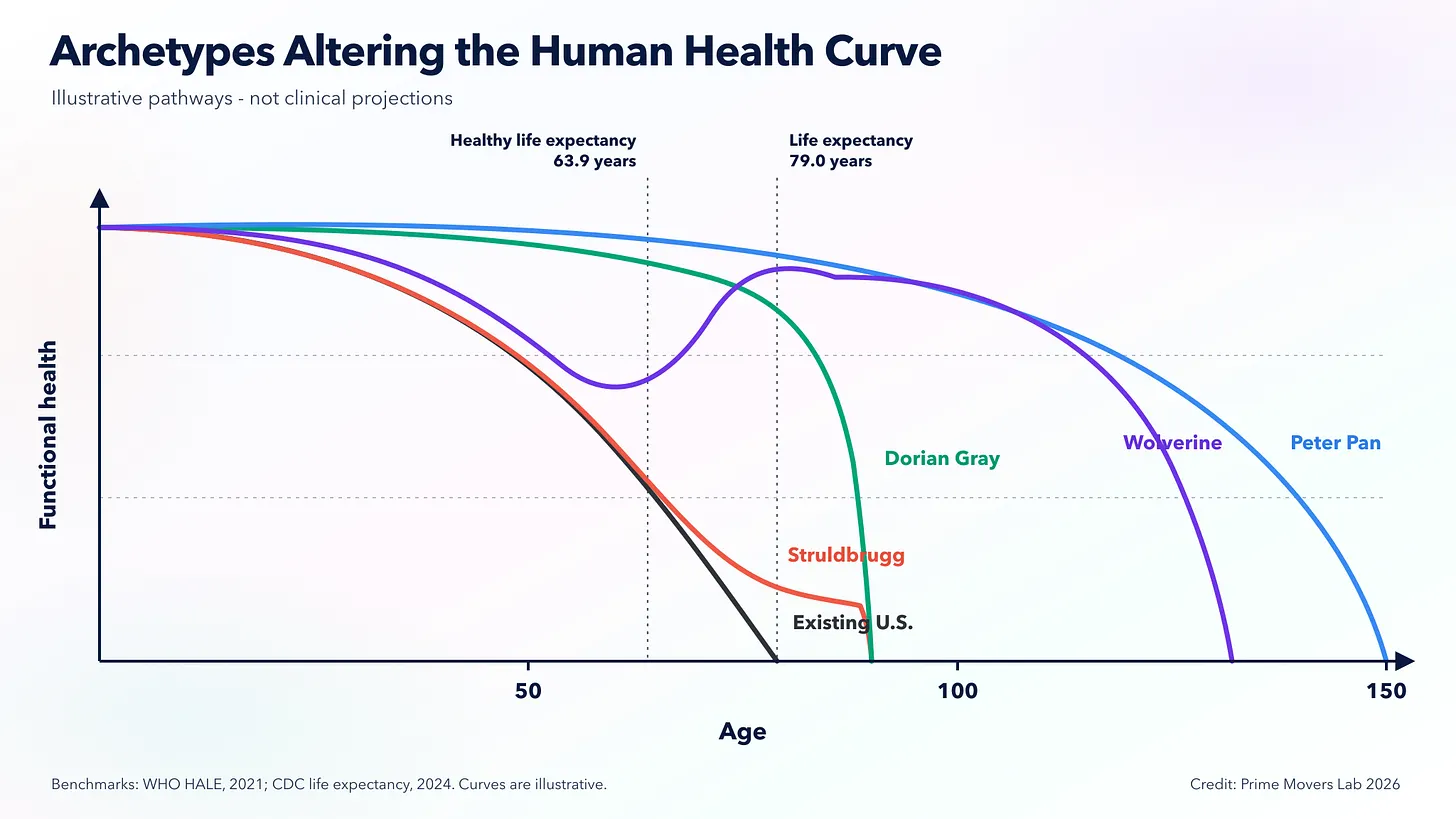
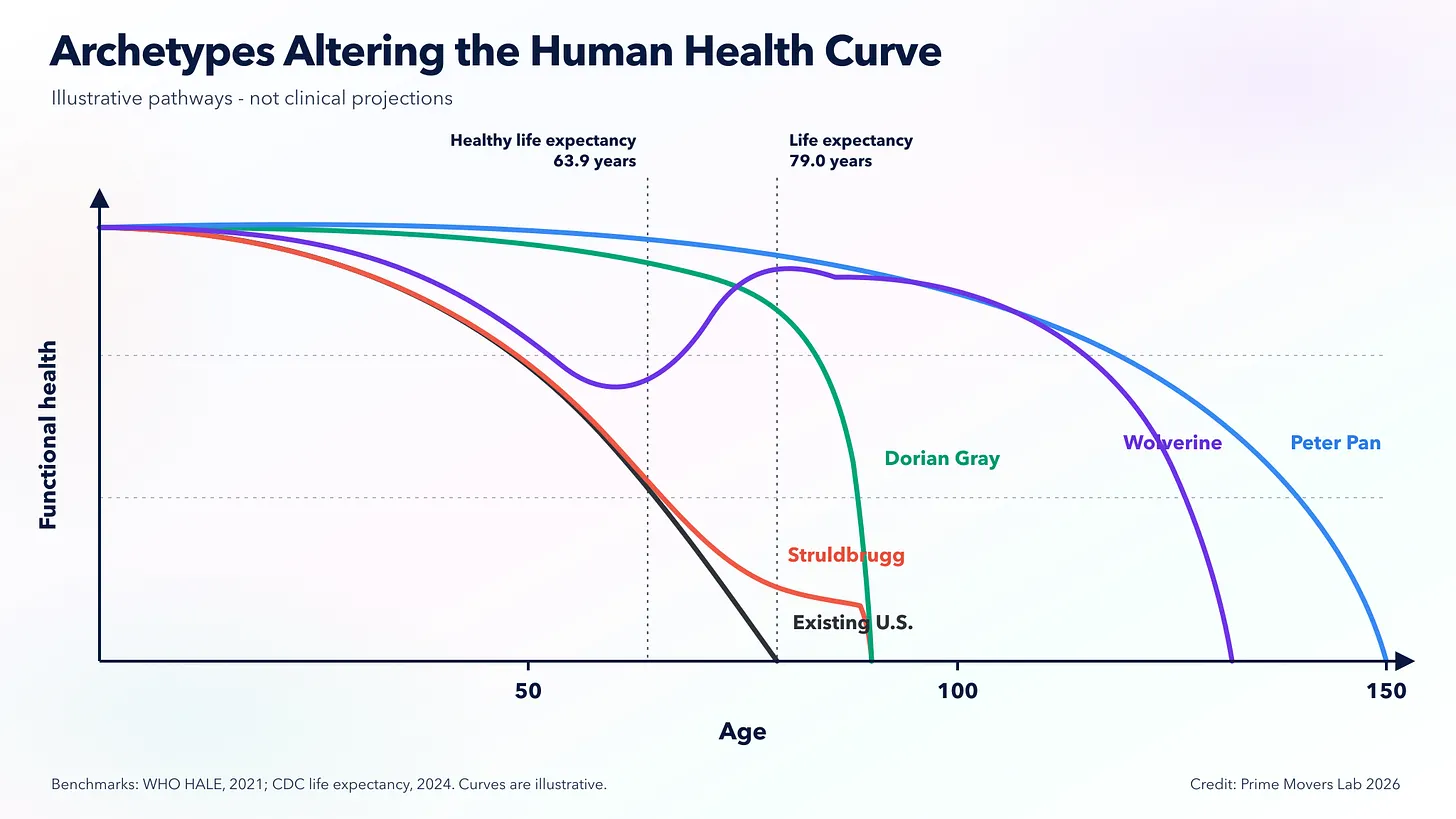
The economists who priced the $38 trillion built their model around four archetypes drawn from literature. It is a useful categorization of the field, because each archetype does something different to the two things we care about, how long we live (life expectancy, LE) and how long we live well (healthy life expectancy, HLE), and each is therefore worth a different amount.
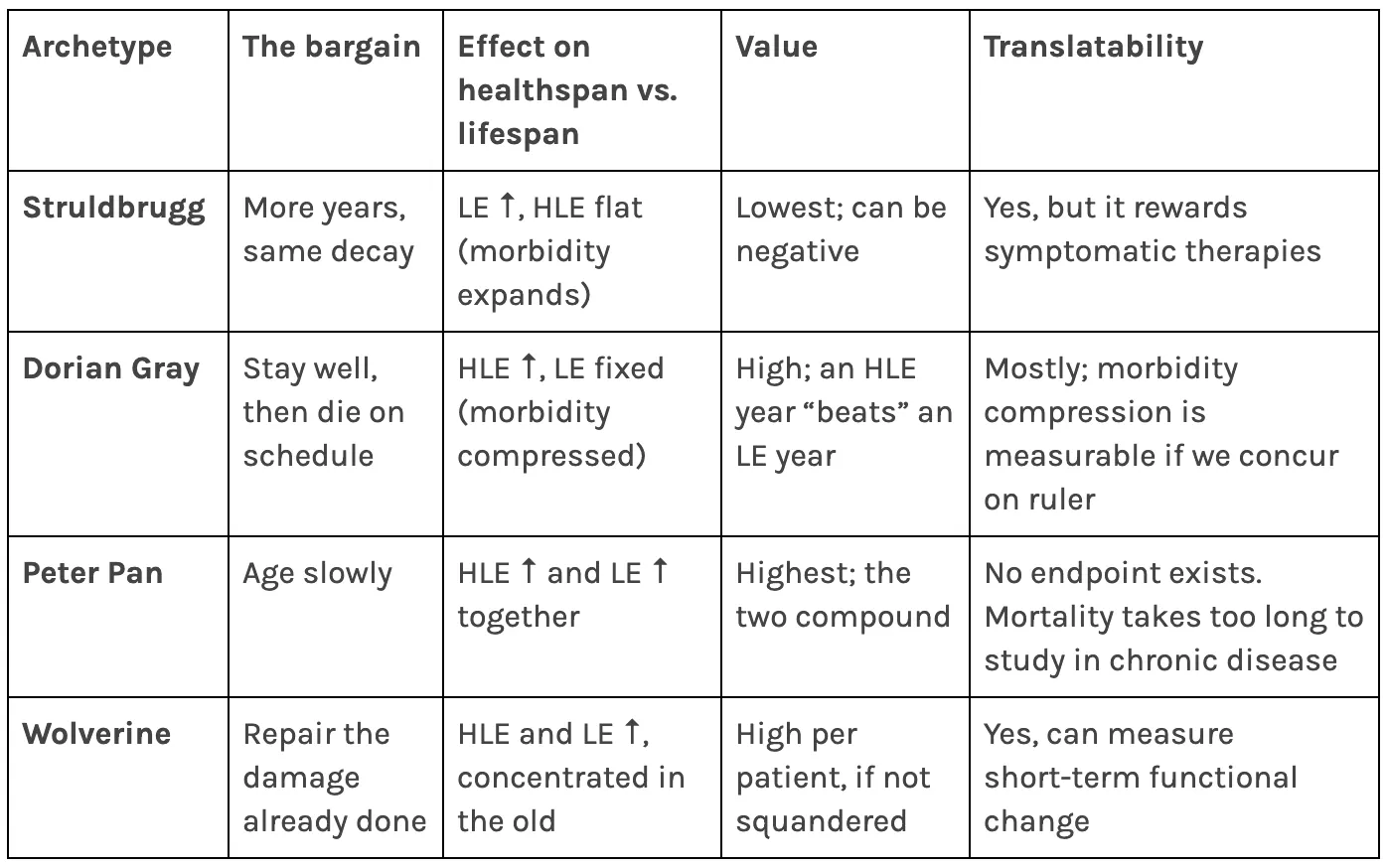
The Struldbrugg is the archetype to fear: Jonathan Swift’s immortals, those walking corpses, who never stop aging and so live forever in worsening health. More time bolted onto the same decay. Like Tithonus, granted eternal life by the Greek Gods, but not protected from frailty, cursed to wither but live on in persistent feebleness. And here is the uncomfortable part: the Struldbrugg is precisely what our medical system is best at producing. Tragically, our regulatory and reimbursement machinery is built for Struldbruggs, not Peter Pans. We are superb at approving drugs that extend survival in advanced disease and mediocre at rewarding drugs that keep people functional in the first place. We’ve optimized for survival, not function; we add years to the end of life far more readily than we add life to our years. QALYs are a pharmacoeconomic tool, used to price a medicine, not approve it. Incentives in the current system point at the archetype that economics says is worth the least.
We’ve optimized for survival, not function; we add years to the end of life far more readily than we add life to our years.
Dorian Gray, Oscar Wilde’s character who stays youthful and whole while a hidden portrait absorbs the damage, until he dies suddenly and intact, would be a significant improvement over a Struldbrugg. The Dorian Gray archetype is compression of morbidity, and the model is unambiguous that an extra year of healthy life is worth more than an extra year of (sick) life, at every age. (Of course, not everyone agrees.) It is also the one archetype our clinical machinery can already handle because “this patient declined at disease measure ‘X’ more slowly” is something we generally know how to address. What it isn’t built for today is actually moving the wall. Dorian Gray squares off the survival curve, meaning more of us arrive at ninety intact, yet ninety stays exactly where it is.

The consequence is incredibly counterintuitive: a famously mediocre drug that nudges five diseases down a little each can generate more “value” than the complete eradication of any one of them. Breadth can beat depth, by a huge margin. But note what you’re buying: mostly healthspan, not lifespan. Only two archetypes offer a chance to move the average lifespan to one hundred. And regulators should prepare, because programs in these categories could enable a world of “average centenarians.”
Peter Pan is the jackpot: J. M. Barrie’s green-tighted boy who simply ages imperceptibly slowly. By Gompertz Law, human mortality doubles roughly every eight years. That doubling time is the rate constant of human aging, and it is stubbornly invariant across populations and eras. Nothing reaches 150 without bending that slope. Halving it would mean moving humans partway toward the naked mole rat, whose mortality barely rises with age at all. Pan the man is a fantasy, but tortoises, some whales, and other species have much slower Gompertz doubling times (called negligible senescence, which we covered several years ago). But why not humans?

What sets the slope of mortality? Increasingly, the evidence points at DNA. Across sixteen mammals, somatic mutation rate scales inversely with lifespan. Indeed, like “tiny, lilliputian scars” humans accumulate roughly 47 mutations per cell per year (mice around 796), and yet every species arrives at the end of their lives carrying a strikingly similar mutation burden, about 3,200 per cell. Different clocks, roughly same alarm. That is the observation underneath this summer’s 146-to-194-year estimate, and its most important implication is one the authors are careful to make: mutations are a weak driver of aging today. We die at seventy-nine of things that are nowhere near this wall.
Which brings me to a key distinction I think matters for anyone allocating capital in this field. Epigenetic reprogramming resets the readout of age. But, for the most part, it does not erase the mutations. Cyclic OSK/M extended progeroid mouse lifespan by about a third and rejuvenates tissue function beautifully. But methylation marks are different from mutations. Restoring a cell’s youthful countenance does nothing about the typos accumulated in its genome. Only genuine DNA repair, either enhanced excision repair, SIRT6-class genome maintenance, or whatever it is the bowhead whale and the naked mole rat are doing that we aren’t, can move it.
That distinction should be uncomfortable, because roughly $4.7 billion of the last four years of longevity venture funding went into reprogramming and epigenetics, and the DNA-repair company layer is nearly empty (save for Matter Bio, Antarka in skin, and few others). In 2016 researchers showed that interventions as different as diet, temperature, oxidative stress, and mutations in HSF-1, HIF-1, and the insulin/IGF-1 pathway all altered C. elegans lifespan by the same move: stretching or compressing time around a single effective rate constant of aging. Change the knob, rescale the clock. Later work found the same temporal scaling in healthspan, with diminishing returns at extreme lifespan extension. The best-replicated single intervention in mammals, rapamycin at high dose, buys 23 to 26% median lifespan in mice. SIRT6 overexpression, ~27% in males. And when the Longevity Escape Velocity Foundation stacked four interventions in a thousand mice, the effects were additive but did not (meaningfully) extend maximum lifespan.
The furthest reprogramming program in the clinic right now goes in through the eye. Life Biosciences’ ER-100 cleared its IND in early 2026, the first partial epigenetic reprogramming therapy to reach humans, targeting retinal ganglion cells. Not the whole body. The retina is immunologically-privileged central nervous system (CNS) tissue into which you can inject (tiny doses) and then photograph. If reprogramming works here, safely, the partial reprogramming field could soon look gain much attention, just like today’s cardiometabolic and psychedelic medicine M&A landscape (see Gilgamesh). If not, such failures at the longevity frontier could be interpreted on the category itself; it would set back a category currently sopping up nearly two-thirds of longevity venture capital, paralleling gene therapy’s struggles. Others, like Gordion Bio are tackling rejuvenation outside reprogramming in indications like osteoarthritis. Durable, systemic rejuvenation of all cells with a single treatment or cocktail has not yet been convincingly demonstrated at the organism level in a sufficiently de-risked and translatable manner. Yet.
Slow the process of aging itself and you improve health and mortality at the same time, and the two compound: the healthier you are, the more you value additional years, and the more years you have, the more you value additional health. This is the virtuous circle that generates the $38 trillion. The problem is not the science. It is that aging is not an approvable indication. There is no box on an FDA form for “treats getting old,” which is why the field keeps trying to smuggle Peter Pan through the door disguised as a treatment for a specific disease, and why the TAME trial and ARPA-H’s healthspan program matter so much: they are attempts to build the door that doesn’t yet exist.
Wolverine is the crucial wild card: the mutant who heals, regenerating tissue and reversing damage already done. This archetype carries the largest per-patient upside in the entire framework, because it restores function directly. It doesn’t need a validated aging clock to prove it worked; you can watch the organ regrow. Regenerative medicine, organ regrowth, young-blood factors (parabiosis) like GDF11, and bioelectric regeneration all live here.
Past ninety, subtraction stops working and you have to start replacing things. The remarkable thing about 2026 is that this stopped being theoretical. Gene-edited pig kidneys are in FDA-cleared trials, yet with only one recipient past nine months of function. Vertex’s islet cell therapy left ten of twelve type 1 diabetics insulin-free at a year. That is a disease functionally cured by replacement. LyGenesis is growing ectopic livers in patients’ own lymph nodes and transplanting entire immune systems via thymic tissue engraftment. Several years ago thymic function was modestly restored directly in men in their sixties with existing approved drugs and hormones.
Kidney, liver, pancreas, thymus, marrow, heart, joints, skin, blood vessels. And all manner of cell types. Given enough time and money, every one of them is replaceable or regrowable … in principle.
Except (perhaps) one.
You cannot currently replace the data organ. No whole head transplants (yet). And adult human neurogenesis is minimal and regionally confined. Neurons are post-mitotic (they were there when you were born and generally intend to stay), which means they cannot dilute their accumulated damage through turnover the way a liver can. And they are a fundamental part of the physical substrate of the person. A perfectly rejuvenated body around a sixty-year-old brain is not a solved problem; it’s a hospice with better vitals. Companies like Retro Bio and others are approaching this, in part, by delivering rejuvenated microglia to restore the brain’s immune substrate. It may be possible to reprogram or even replace neurons while maintaining brain function and memory, while we’ll just simply note the future potential for ‘novel’ adverse events as the programs mature. A rat still remembering a maze post treatment doesn’t tell us enough to not be concerned about human trials.

But Wolverines carry two traps. The first is the narrow trap: a therapy that could, in principle, regenerate many tissues but chooses to prove itself only in a single niche indication captures a sliver of what it is worth. The second is the COGS trap: a cell or gene therapy with genuine breadth, priced like a bespoke product, fails the cost-effectiveness threshold anyway. The authors’ own warning bites here: if costs are high, access collapses and the social value is never realized.
The investment reading: Peter Pan holds the largest theoretical share of the $38T because it’s the only archetype with complementarity and a virtuous circle. Dorian Gray is the most defensible clinically because compression of morbidity is a more measurable, approvable idea. Wolverine has the steepest value curve in the old, which is also the population where cost and comorbidity make trials hardest. Struldbrugg is the trap, and more pharmaceutical drug development programs fall into it than anyone admits.
The value of breadth
There is a respectable case for narrow bets. A drug aimed at a small orphan indication can be a genuinely good business: payers tolerate a high price per QALY for a devastating rare disease, the regulatory path is often faster(ish), the competition thinner, and the returns real. Narrow orphan indications can be great opportunities; I am not dismissing them.
But they are, by construction, points near the bottom of the value curve. They help few people, so they can only ever capture a small corner. Meant to treat diseases where no therapy exists, when developed as intended the regulatory mechanism works and stranded patients get crucial therapies. For others, niche diseases (not necessarily true orphan diseases) work best as “gateway indications,” a proving ground for safety and efficacy in a defined population before further trials in larger populations. The Office of Orphan Products has, though, moved to curb such blatant “salami slicing,” arguing that orphan diseases should not subsidize broader drug development efforts, so drug hunters need to chart their course carefully.
Now here’s the part that should keep longevity investors humble. When you actually stack interventions, biology pays you back roughly additively, not multiplicatively. The NIA Interventions Testing Program found that rapamycin plus acarbose (two of the best single agents, acting through partly distinct pathways) extended mouse median lifespan by about 22% across trials and up to ~28–34% starting early, with the combination behaving additively in males (and, tellingly, not additively in females). Trametinib and rapamycin likewise combine additively to extend mouse lifespan. The broader literature on combining interventions against multiple hallmarks reaches the same verdict: monotherapy is inefficient, combinations help, and the gains can stack. But they stack, they don’t explode. The LEV Foundation’s 1,000-mouse RMR1 study produced an even messier warning: its four-treatment cocktail improved survival but did not materially extend maximum lifespan. In females, rapamycin alone performed nearly as well as the full combination; in males, the combination outperformed rapamycin, suggesting sex-specific potentiation rather than clean additivity.
So the biological curve, or the healthspan gained as a function of how much of aging’s breadth is addressed, is real, positive, and concave: additive returns, bending over at the top. If the story ended here, breadth would be a nice-to-have, not a thesis. It doesn’t end there, because value does not track biology one-for-one. Three forces bend the value curve upward exactly where the biological curve breaks.
Competing risks
Because aging is the shared substrate, reducing any one disease matters more when the others are also reduced — the longevity complementarity built into the model. Address the substrate (curing cancer, heart disease, and so on) and every disease curve moves together, compounding.
Rising comorbidity
The older and sicker the population, the more diseases each person carries, so a broad intervention’s impact compounds across an ever-larger comorbid base.
The virtuous circle
If slowing aging makes society older and larger, it raises the willingness to pay for further slowing. Measured biologically as a percentage slowdown rather than a fixed year, the individual willingness to pay actually increases with each increment. Increasing sector returns, formally.
The scales really tip with breadth: a single mechanism that reaches across many diseases at once. The value of a longevity therapy scales super-linearly with the breadth of quality-adjusted life it can touch — a scaling law of sorts — even though the underlying biology only adds up arithmetically. Competing risks, which are a curse for single-disease cures, become a blessing for a broad one: every disease it dents makes every other worth more.
The GLP-1 drugs are the current prime example. A single mechanism has now posted positive trials across obesity, cardiovascular disease, kidney disease, heart failure, sleep apnea, peripheral artery disease, and liver disease. You cannot simply add those patient populations (the same obese, diabetic, kidney-impaired patient appears in every one) so the honest unit is the treated person. De-duplicated, the class reaches something like 110 million American adults at roughly quarter-to-half a quality-adjusted year each, which translates to trillions in societal value from one mechanism. And, unusually, much of it is cost-effective enough to actually get reimbursed. That is what tipping the scales looks like (even airlines are feeling the impacts). Many call the new triple-agonist, retatrutide, a potential “trillion dollar drug.” Indeed, no single-disease therapeutic comes within an order of magnitude. Several more hits like GLP-1 and we’ll get there. Just that easy, right?
But breadth is not a given. The most closely watched GLP-1 expansion into Alzheimer’s disease read out in late 2025 and missed: the biomarkers moved, the cognition didn’t. Breadth is a portfolio of bets on where a mechanism will reach, and some of them come back empty. And it is expensive. But even after writing the failures to zero, the breadth play dwarfs anything narrow. We must take big swings if we want to move the needle on longevity.
Theoretical breadth is a rubric; realized value is the practicality of how a drug is actually taken up by the treatment population:
- Route and adherence: A majority of adults starting an incretin for weight quit within a year, and multi-year persistence runs in the teens so the oral race is a value story, not just a convenience one.
- Redosability: One-shot AAV gene therapies hit a wall (neutralizing antibodies preclude most repeat dosing), capping lifetime value for a chronic process like aging.
- Cost of Goods (COGS): Even cost-effective incretins can only treat a few percent of eligible Americans before blowing through what the system absorbs in a year. The realities of manufacturing combinations, complex delivery formulations, autologous cell therapies, and last-mile personalized medicine could limit the impact and commercializability of some of our most efficacious therapies.
Mapping the longevity prize
Metabolic disease and obesity is the giant that is already tipping. These drugs are also increasingly taken by younger populations and the non-obese for optimal weight and its other benefits. Risks from long-term use are still being sussed out (and inevitably, litigated) such as bone and eye issues either attributed to the drug or the rapid weight loss. Companies like Rejuvenate Bio and others are working toward a future where gene therapy could tune one’s metabolism for a lifetime with a single shot, and who are already meaningfully impacting and extending the lives of pets with such therapies.
Neurodegeneration is the largest healthy-life prize in medicine and, right now, the worst returns: The approved amyloid antibodies deliver a fraction of a QALY at a six-figure price, landing above every reimbursement threshold. The disease is enormous, but the increment is too small to pay for in the current system. That is the definition of white space; the prize is real, the biology simply isn’t solved yet. Retro Bio appears here as well, however not with another cell therapy but a small molecule autophagy enhancer to counteract tangleopathies (diseases of toxic protein accumulation) starting with a genetic form of Alzheimer’s.
Frailty and sarcopenia may be the most under-appreciated opportunity of all: The condition that most directly destroys healthy years, cutting across every organ system, and yet it has no approved indication and no consensus endpoint. This is the purest Dorian Gray target, and the moat is not a molecule, it is the endpoint. Whoever builds the regulator-grade way to measure multi-system decline unlocks reimbursement for an entire class and owns the category. We have multiple approved myostatin and activin inhibitors as well as SARMs with promising results (albeit troubling class-level side effects) and yet little market traction as a result of this lack of regulatory clarity. Ultimately the drugs didn’t make the weak patients automatically stronger, they just gave them a bit more muscle tissue. Some argue the endpoints made readouts hard to interpret. Without a clear path around sarcopenia, will regulators ever be able to change their tune on aging as a disease? Perhaps, if Celine and the team at Loyal get a key win in dogs.
Immune aging and inflammaging sit upstream of nearly everything (the through-line of the chronic diseases I wrote about in 2022) and remains strikingly under-built relative to its reach despite several programs from Rubedo, BioAge, and others.
Organ regeneration is in the Wolverine lane. It carries the highest value per patient in the landscape, gated by two things: the cost of goods, and the temptation to niche into a narrow indication. We’ve been very active here with investments in IVIVA Medical (acquired by United Therapeutics), LyGenesis (lymph node bioreactors), and Morphoceuticals (bioelectric tissue regeneration).
Cancer and cardiovascular disease are vast but, as the competing-risks math shows, limited per cure and served by efficient, crowded markets. The longevity angle there is a passenger, not the driver. Rejuvenate Bio’s work in mitral valve disease with FGF21 and TGFb2R gene therapies and both Cyclarity and Repair Bio’s programs in atherosclerosis are ones to watch.
Any honest accounting reckons with who pays. Social Security’s retirement fund is projected to run short in the early 2030s, Medicare’s hospital fund soon after, as more than four million Americans turn sixty-five every year. Extending lifespan without health (the macro Struldbrugg) deepens that crisis. Compressing morbidity flips the sign: healthier people work longer, claim later, and cost less at the end. The fiscal question isn’t whether to extend life; it’s which archetype we buy. That’s the real argument for organizing medicine around healthspan; not that it’s more humane, though it is, but that it may be the only version the public balance sheet can afford. That is, provided what we build is health, not merely time.
Building for Peter Pan: Second star to the right and straight on
Ignore the top-down trillions, and build a bottom-up plan around a therapy with a clear near-term market and a broad follow-on strategy. This works in traditional biotech, too, but if the next indications aren’t driving toward healthspan or healthy life extension, then it was never really a longevity drug. The winning longevity companies will carefully modulate core mechanisms yet target relatively narrow, measurable, payable front doors (lead indications). Going after Peter Pan biology in the current environment necessitates entering through a single indication with an efficacy delta large enough to get paid, then expanding across the disease map the way GLP-1s have. Breadth for value; focus for capture. A Wolverine that resists the orphan trap. A Dorian Gray that finally moves the healthspan gap instead of narrating it.
And the system around them has to change. A reimbursement regime that pays for survival but not for function will keep manufacturing Struldbruggs. The most valuable regulatory reform in medicine would be an approvable path for multimorbidity — an endpoint that rewards a drug for reducing the incidence of aging itself, across diseases, rather than forcing every therapy to masquerade as a treatment for one. There’s some indication FDA might consider multimorbidity “basket” trials, a concept borrowed from oncology clinical development, but it is not yet accepted as an indication itself. Escape velocity, if it ever comes, will not arrive as a single miraculous cure. It will be the integral of a thousand broad, unglamorous wins or the slow accumulation of healthy years across the whole population, one cost-effective indication at a time.
Is cheating death worth it? Emphatically yes, but only if we add the right kind. Adding years of decline to the end of life is worth little, and we are alarmingly good at it. Adding healthy years to compress the decade-plus of sickness we currently accept as the cost of a long life is worth more than almost anything else we could do with the money. UBS estimates the longevity market at roughly $8 trillion. While I won’t argue with their proposal that equities investors allocate roughly 5% of their portfolio to longevity, it is still a useless market number for founders today. QALYs are decision-irrelevant at the bench and decision-determinative at launch. Founders should model them backward from launch instead of ignoring them.
The $38 trillion is economic possibility, not tangible product-market impact, so it cannot be used to support the value of a founder’s specific program. If aging is the disease, then the prize goes not to whoever cures one more of its symptoms, but to whoever treats the most of it, in the most people, for the longest time. That is the bet worth making. Next time, we’ll start salami slicing, and carve out each category to build bottom up estimates for what each category might look like as it matures.
Sources & Supplementary Reading
Scott, Ellison & Sinclair, The economic value of targeting aging and the archetype commentary, Nature Aging 2021 · competing-risks / delayed-aging returns, USC Today · healthspan–lifespan gap, Garmany & Terzic 2025 · U.S. cost-effectiveness thresholds, ICER vs NICE · GLP-1 obesity cost-effectiveness, ICER 2025; SELECT EHJ-QCCO 2025; FLOW ADA 2024; SURMOUNT-OSA FDA 2024; STRIDE Lancet 2025; MASH/ESSENCE AJMC 2025; EVOKE Alzheimer’s Association 2025 · Alzheimer’s antibody pricing, Alzheimer’s & Dementia 2025 · sarcopenia’s missing indication, GeroScience 2023 · temporal scaling of aging, Stroustrup, Nature 2016 · TAME, AFAR; ARPA-H VITAL-H.